
Knowledgebase (2523)
Children categories
The most important reason that people lock worksheet when perform tasks in Excel is to protect the original Excel file from editing or modifying by other people. Through Microsoft Excel, you can set the entire Excel worksheet by setting its property as Read Only or just set partial region area cells as Read Only via protecting worksheet. While how to lock worksheet with C#, VB.NET will be the core topic in this section.
Spire.XLS for .NET, as a fast and reliable excel component, enables you to lock your worksheet by setting Worksheet class property: Worksheet.Range.Style.Locked = true. By this component, you can lock any worksheet that you need. In this solution, worksheet one and worksheet two are locked as you view in below picture:
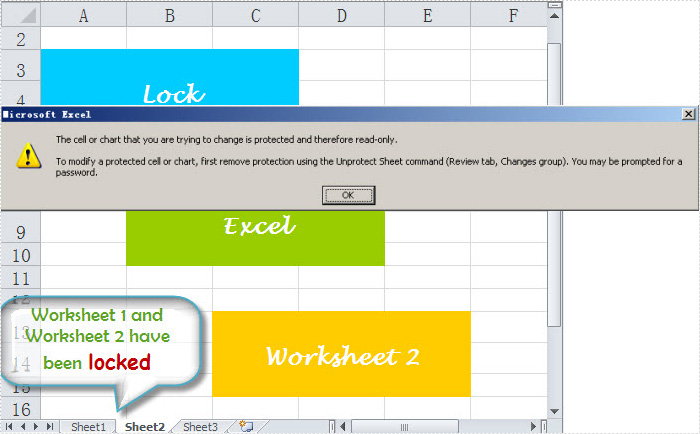
Now, before the detail code, you have to add Spire.Xls dll by download Spire.XLS for .NET.
using Spire.Xls;

namespace lock_excel_worksheet
{
    class Program
    {
        static void Main(string[] args)
        {
            Workbook workbook = new Workbook();
            workbook.LoadFromFile(@"..\lock worksheet.xls");
            workbook.Worksheets[0].Range.Style.Locked = true;
            workbook.Worksheets[1].Range.Style.Locked = true;
            workbook.Worksheets[0].Protect("", SheetProtectionType.All);
            workbook.Worksheets[1].Protect("", SheetProtectionType.All);
            workbook.SaveToFile("result.xls",ExcelVersion.Version97to2003);
        }
    }
}
Imports Spire.Xls

Namespace lock_excel_worksheet

    Class Program

        Private Shared Sub Main(ByVal args() As String)
            Dim workbook As Workbook = New Workbook
            workbook.LoadFromFile("..\lock worksheet.xls")
            workbook.Worksheets(0).Range.Style.Locked = true
            workbook.Worksheets(1).Range.Style.Locked = true
            workbook.Worksheets(0).Protect("", SheetProtectionType.All)
            workbook.Worksheets(1).Protect("", SheetProtectionType.All)
            workbook.SaveToFile("result.xls",ExcelVersion.Version97to2003)
        End Sub
    End Class
End Namespace
Spire.XLS allows user to operate Excel document directly such as save to stream, save as web response, copy, lock/unlock worksheet, set up workbook properties, etc. As a professional .NET/Silverlight Excel component, it owns the ability of inserting content into Excel document, formatting cells and converting Excel documents to popular office file formats. Spire.XLS for .NET supports Excel 97-2003, Excel 2007 and Excel 2010.
Why Export Listview to CSV?
CSV file (Comma Separated Values, sometimes also called Comma Delimited) is a specially formatted plain text file which stores spreadsheet or basic database-style information in a very simple format, with one record on each line, and each field within that record separated by a comma. It is often used to exchange data between disparate applications. CSV has become a pseudo standard throughout the industry, even among non-Microsoft platforms because it is used in Microsoft Excel.
CSV files are often used as a simple way to transfer a large volume of spreadsheet or database information between programs, without worrying about special file types. For example, transferring a home-made address book from Excel into a database program such as Filemaker Pro could be done by exporting the file as a CSV from Excel, then importing that CSV into File maker.
How to Export Listview to CSV?
Spire.DataExport for .NET presents an easy solution for exporting Listvie to CSV. Spire.DataExport is a 100% pure .NET component suit for exporting data into MS Excel, MS Word, HTML, XML, PDF, MS Access, DBF, SQL Script, SYLK, DIF, CSV ,MS Clipboard format. Quickly and easily export data from Command, ListView, DataTable components. Save you much time and money by using Spire.DataExport.
Download Spire.DataExport (or Spire.Office) with .NET framework 2.0 (or above) together and use the code below to Export Listview to CSV:
this.txtExport1.ActionAfterExport = Spire.DataExport.Common.ActionType.OpenView;
    this.txtExport1.DataFormats.CultureName = "en-us";
    this.txtExport1.DataFormats.Currency = "c";
    this.txtExport1.DataFormats.DateTime = "yyyy-M-d H:mm";
    this.txtExport1.DataFormats.Float = "g";
    this.txtExport1.DataFormats.Integer = "g";
    this.txtExport1.DataFormats.Time = "H:mm";
    this.txtExport1.DataEncoding = Spire.DataExport.Common.EncodingType.ASCII;
    this.txtExport1.DataSource = ExportSource.ListView;
    this.txtExport1.ListView = this.ListView1
    txtExport1.ExportType = TextExportType.CSV;
    txtExport1.FileName = "sample.csv";
    txtExport1.SaveToFile();
Me.txtExport1.ActionAfterExport = Spire.DataExport.Common.ActionType.OpenView
            Me.txtExport1.DataFormats.CultureName = "en-us"
            Me.txtExport1.DataFormats.Currency = "c"
            Me.txtExport1.DataFormats.DateTime = "yyyy-M-d H:mm"
            Me.txtExport1.DataFormats.Float = "g"
            Me.txtExport1.DataFormats.Integer = "g"
            Me.txtExport1.DataFormats.Time = "H:mm"
            Me.txtExport1.DataEncoding = Spire.DataExport.Common.EncodingType.ASCII
            Me.txtExport1.DataSource = Common.ExportSource.ListView
            Me.txtExport1.ListView = Me.ListView1
txtExport1.ExportType = TextExportType.CSV
                        txtExport1.FileName = "sample.csv"
                        txtExport1.SaveToFile()
Why Export Listview to Office OpenXML?
Office OpenXML has its own advantages. Office OpenXML, or Extensible Markup Language is a set of rules for encoding documents in machine-readable form. The real power of Office OpenXML comes from the fact that with Office OpenXML, not only can you define your own set of tags, but the rules specified by those tags need not be limited to formatting rules. And the most benefit of Office OpenXML is that because you are writing your own markup language, you are not restricted to a limited set of tags defined by proprietary vendors. Furthermore, Office OpenXML allows you to define all sorts of tags with all sorts of rules, such as tags representing business rules or tags representing data description or data relationships.
How to Export Listview to Office OpenXML?
As a professional and powerful .NET component suit for data exporting, Spire.DataExport for .NET can export data from Database to MS Excel,MS Word, HTML, Office OpenXML, PDF, MS Access, DBF, SQL Script, SYLK, DIF, CSV ,MS Clipboard format and of course enable to export ListView to Office OpenXML.
Spire.DataExport for .NET offers an easy solution on Exporting listview to Office OpenXML. Download Spire.DataExport (or Spire.Office) with .NET framework 2.0 (or above) together and use the code below to Export Listview to Office OpenXML:
this.xmlExport1.ActionAfterExport = Spire.DataExport.Common.ActionType.OpenView;
			this.xmlExport1.DataFormats.CultureName = "zh-CN";
			this.xmlExport1.DataFormats.Currency = "c";
			this.xmlExport1.DataFormats.DateTime = "yyyy-M-d H:mm";
			this.xmlExport1.DataFormats.Float = "g";
			this.xmlExport1.DataFormats.Integer = "g";
			this.xmlExport1.DataFormats.Time = "H:mm";
			this.xmlExport1.FileName = "sample.xml";
            this.xmlExport1.DataSource = Common.ExportSource.ListView;
            this.xmlExport1.ListView = this.listView1;
oleDbConnection1.Open();
try{
xmlExport1.SaveToFile();
}
Finally
{
oleDbConnection1.Close();

}
Me.xmlExport1.ActionAfterExport = Spire.DataExport.Common.ActionType.OpenView
            Me.xmlExport1.DataFormats.CultureName = "zh-CN"
            Me.xmlExport1.DataFormats.Currency = "c"
            Me.xmlExport1.DataFormats.DateTime = "yyyy-M-d H:mm"
            Me.xmlExport1.DataFormats.Float = "g"
            Me.xmlExport1.DataFormats.Integer = "g"
            Me.xmlExport1.DataFormats.Time = "H:mm"
            Me.xmlExport1.FileName = "sample.xml"
            Me.xmlExport1.DataSource = Common.ExportSource.ListView
            Me.xmlExport1.ListView = Me.listView1
oleDbConnection1.Open()
            Try
                 xmlExport1.SaveToFile()
Finally
                Me.oleDbConnection1.Close()
            End Try
