How to Password Protect a PDF File for Free (5 Easy Ways)
Table of Contents
- How to Password Protect a PDF for Free Online
- Password Protect a PDF on Mac for Free Using Preview
- How to Encrypt a PDF for Free with Desktop Applications
- Password Protect PDFs Automatically with Free Spire.PDF
- How to Password Protect a PDF When Exporting from Word
- PDF Encryption Methods Comparison
- FAQs
Sharing confidential documents as PDFs can put sensitive information at risk if they are not properly secured. Adding password protection helps control who can open, edit, copy, or print your files. Fortunately, you don't need expensive software or an Adobe Acrobat subscription to encrypt a PDF. In this guide, you'll learn five ways to password protect a PDF for free, including online tools, built-in applications, desktop software, Python automation, and Microsoft Word.
- How to Password Protect a PDF for Free Online
- Password Protect a PDF on Mac for Free Using Preview
- How to Encrypt a PDF for Free with Desktop Applications
- Password Protect PDFs Automatically with Free Spire.PDF
- How to Password Protect a PDF When Exporting from Word
- PDF Encryption Methods Comparison
- FAQs
How to Password Protect a PDF for Free Online
If you need to lock a PDF document right away without installing new software, online tools are the quickest method. They work across Windows, macOS, iOS, and Android. Popular platforms like Adobe Acrobat Online Free Tool, iLovePDF, and Smallpdf allow you to set strong passwords in just a few clicks.
Here's how to encrypt a PDF file for free using Smallpdf:
- Step 1. Navigate to Smallpdf's Protect PDF tool in a browser.
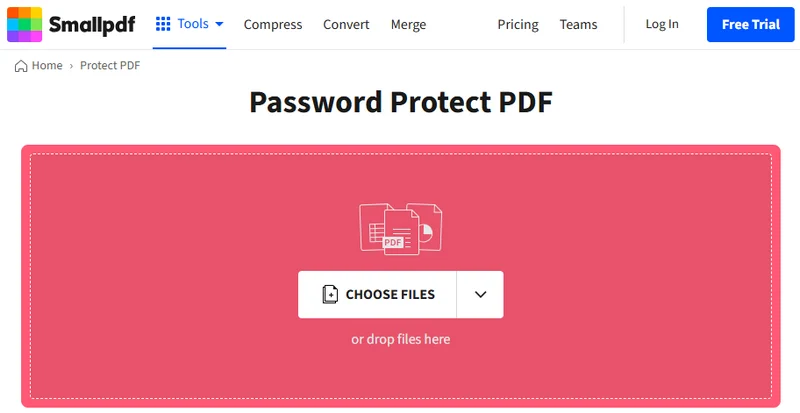
- Step 2. Upload a PDF document and type in a password.
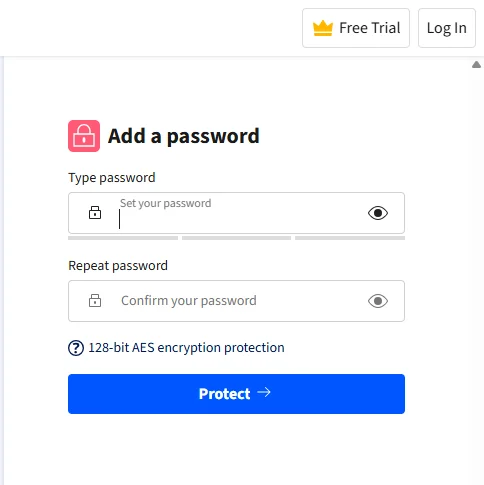
- Step 3. Tap on the Protect button and download the encrypted PDF.
Note: Most online PDF editors claim to delete uploaded files within 24 hours. However, avoid uploading sensitive personal or business documents. For confidential files, choose an offline method instead.
Password Protect a PDF on Mac for Free Using Preview
If you use macOS, you already have a powerful, built-in PDF editor on your computer. The Preview app allows you to encrypt PDF files instantly without connecting to the internet.
Follow these steps to lock PDF documents on Mac:
- Step 1. Double-click your PDF file to open it in the Preview app.
- Step 2. Click File in the top menu bar and select Export... (or Edit Permissions... depending on your macOS version).
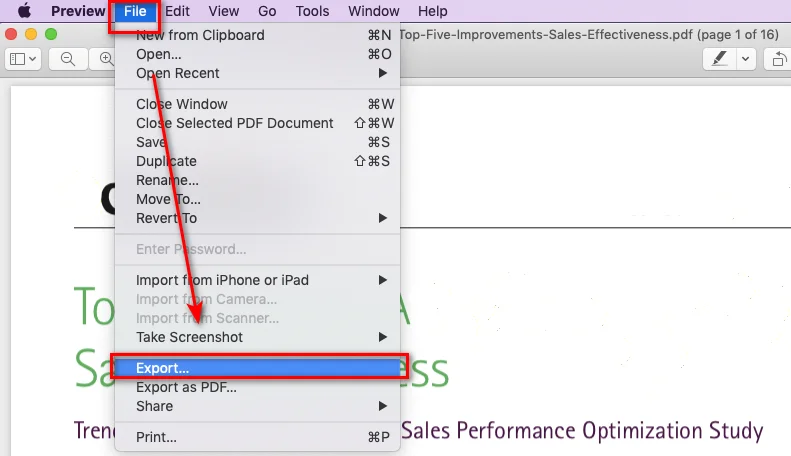
- Step 3. Click the Permissions... button at the bottom of the export window.
- Step 4. Check Require Password To Open Document, type your password, and re-enter it to confirm. But the available options may vary depending on your macOS version.
- Step 5. Click Apply, then click Save.
How to Encrypt a PDF for Free with Desktop Applications
If you are using Windows, the operating system does not include a built-in tool for directly password protecting existing PDF files. In this case, a free desktop PDF application can help you encrypt files locally without uploading them to online services. Tools like PDFEncrypt provide an easy way to add password protection and encryption to PDF documents.
Here is how to lock your file using PDFEncrypt on Windows:
- Step 1. Download, install, and launch PDFEncrypt.
- Step 2. Click Source File to select the target PDF document, and set the destination of the locked PDF.
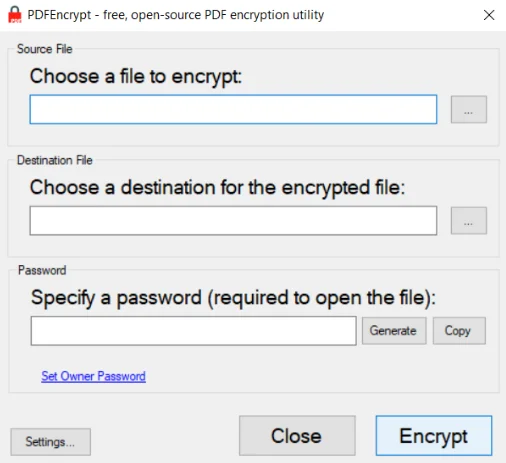
- Step 3. Enter an opening password. You can also set an owner password to restrict printing or copying content.
- Step 4. Click Encrypt to protect the PDF.
Password Protect PDFs Automatically with Free Spire.PDF
While the above tools are great for single PDFs, manually locking dozens of PDFs one by one is inefficient. This is when Free Spire.PDF for Python comes to help by automating PDF encryption. It allows developers to apply open and permission passwords to PDF files with just a few lines of code.
Code Example
With the help of Free Spire.PDF, securing PDF files takes just three simple steps:
- Load the PDF file.
- Call Security.Encrypt() to apply password protection.
- Save the encrypted PDF.
Here is the complete code snippet:
from spire.pdf import *

# Initialize the PdfDocument object
doc = PdfDocument()

# Load the target PDF file
doc.LoadFromFile("/input/Sample.pdf")

# Encrypt the PDF with user and owner passwords
doc.Security.Encrypt("openPsd", "permissionPsd", PdfPermissionsFlags.Print, PdfEncryptionKeySize.Key128Bit)

# Save the password-protected PDF to a new file
doc.SaveToFile("/output/protected_sample.pdf")
doc.Close()
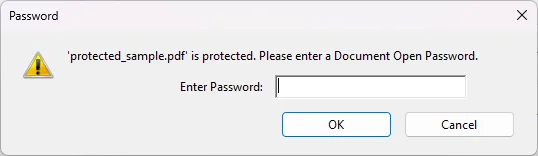
Opening the output PDF will now display a password prompt, indicating successful encryption:
You may like: How to Make a PDF Read Only in 2025 (A Complete Guide)
How to Password Protect a PDF When Exporting from Word
What if you haven't created the PDF file yet? If you are preparing your document in Microsoft Word, you don't need a separate PDF encryption tool. Word allows you to save the document as a PDF and add password protection during the export process.
- Step 1. Open your document in Microsoft Word.
- Step 2. Go to File > Save As and choose PDF as the file format.
- Step 3. Click the Options... button near the format selector.
- Step 4. Check Encrypt the document with a password at the bottom of the pop-up window.
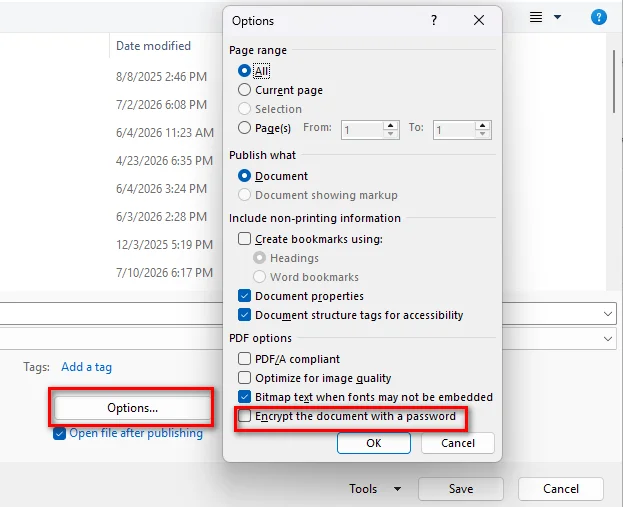
- Step 5. Click OK, enter your password, and save the secured PDF.
PDF Encryption Methods Comparison
To help you choose the right method, the following table compares each option based on privacy, supported platforms, and setup requirements:
| Method | Best For | Privacy Level | Platform | Setup Required |
|---|---|---|---|---|
| Online Tools | Quick protection for one-time PDF tasks | Moderate (cloud upload) | All Browsers | None |
| Mac Preview | Mac users needing offline PDF protection | High (local processing) | macOS | Built-in |
| Windows Desktop App | Protecting sensitive files on Windows | High (local processing) | Windows | Free Download |
| Free Spire.PDF for Python | Developers and batch PDF encryption | High (local processing) | Cross-platform | pip install |
| Microsoft Word Export | Creating password-protected PDFs while exporting | High (local processing) | Windows | Microsoft Office |
FAQs about Password Protecting PDFs
What is the difference between an Open Password and a Permission Password?
An open password (user password) prevents anyone from opening and viewing the file without entering the code. A permission password (owner password) allows users to open and read the document, but stops them from making changes, printing pages, or copying text.
Can I password protect a PDF without downloading extra software?
Yes, Mac users can rely on Preview, while users on any platform can choose online PDF protection tools. If you need offline protection on Windows, a free desktop application is also available.
Is it safe to encrypt a PDF online?
Generally, it is safe, but uploading sensitive or personal data to web tools is not recommended. If your PDF contains critical information, try offline desktop software or Free Spire.PDF for Python instead.
Conclusion
This guide covered five free ways to password protect a PDF, from quick online tools and built-in applications to desktop software, Python automation, and Microsoft Word export options. Each method is suitable for different situations: online tools work well for quick tasks, offline solutions provide better privacy, and automation is ideal for processing multiple files. Choose the method that best matches your security needs and workflow.
Also Read:
How to Remove Comments from PDF: with or without Adobe
Table of Contents
Whether you are preparing a final contract, submitting a thesis, or sharing a report with clients, removing internal comments, highlights, and review notes helps to maintain a professional appearance and prevents accidental data exposure.
In this guide, we will show you how to remove comments from PDF documents with three approaches. Depending on your needs, you can use Adobe Acrobat, free online tools, or an automated Python script.
- How to Delete All Comments in Adobe
- Remove Comments from PDF Online
- Remove Annotations from PDF Automatically with Python
- FAQs
How to Delete All Comments in Adobe
Adobe Acrobat is one of the most popular ways to manage and clean up PDFs. It allows you to remove comments using built-in features. Here is how to delete all comments in Adobe using two different approaches.
1. Bulk Select via the Comment Pane
This method is useful when you want to remove annotations from PDF quickly without hassle. Here are the detailed steps:
- Step 1. Open a PDF in Adobe Acrobat.
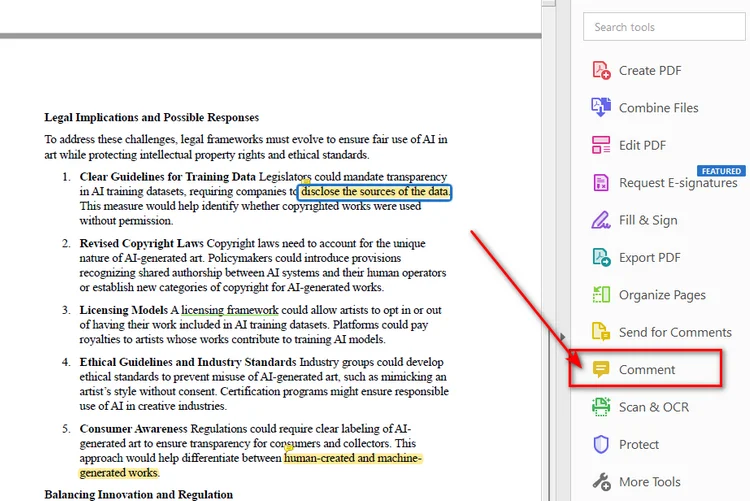
- Step 2. Open the comment panel by clicking the Comment icon in the right-hand toolbar.
- Step 3. Left-click the first comment at the top of the panel.
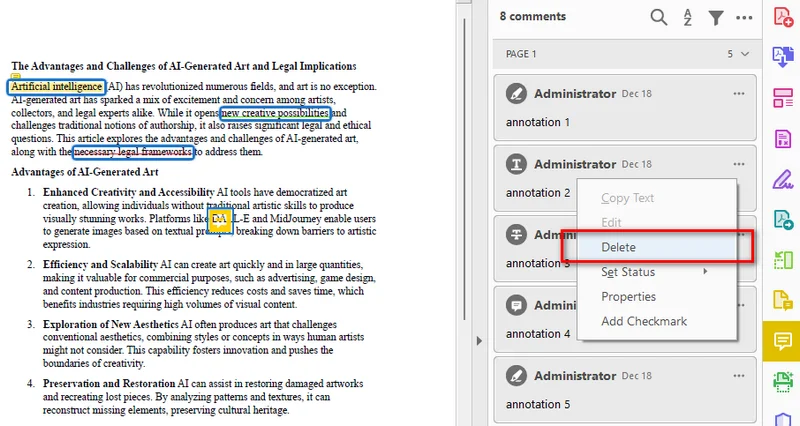
- Step 4. Scroll down to the bottom of the list, hold down the Shift key on your keyboard, and click the last comment to select all annotations.
- Step 5. Right-click anywhere on the highlighted list and select Delete.
2. Use the Sanitize Document Feature
If you are dealing with a highly confidential document, manual deletion might miss hidden data. Acrobat's Sanitize feature can remove hidden information, including comments, metadata, and other private content.
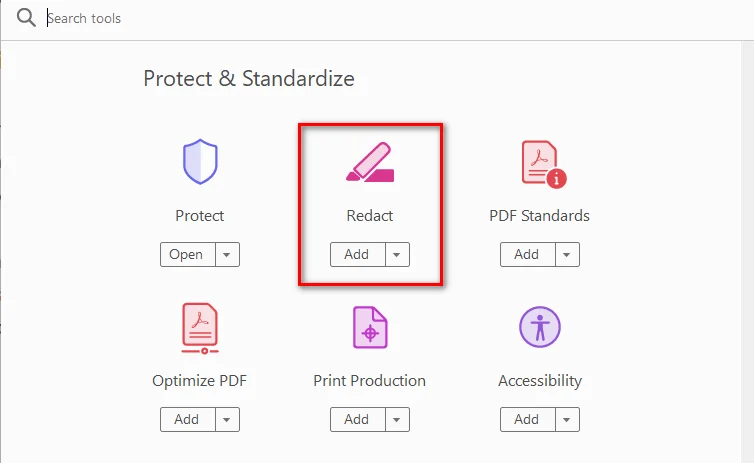
- Step 1. Go to the top menu and select Tools -> Redact.
- Step 2. Click on the Sanitize Document button in the top bar.
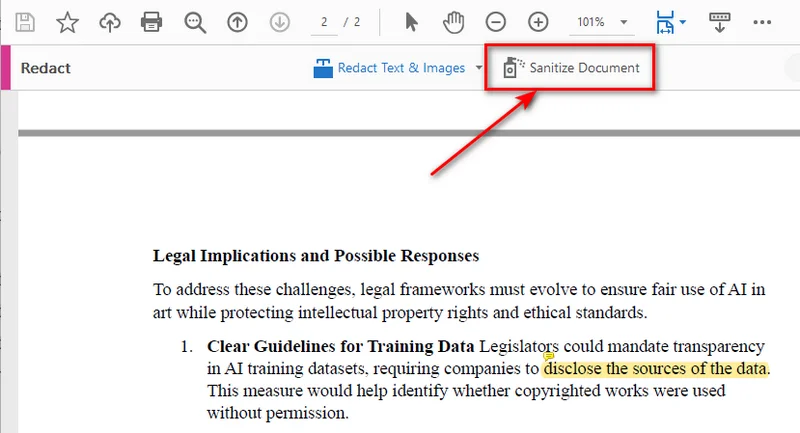
- Step 3. A pop-up will appear. Click OK to permanently strip all hidden comments, revision histories, and private metadata.
Note: Using this way, Adobe will automatically create a new and clean version of PDF. This leaves your original PDF untouched, making it perfect for keeping an internal copy with your comments intact while creating a clean draft for others.
You may like: How to Make a PDF Read Only in 2025 (A Complete Guide)
How to Remove Comments from PDF Online (Without Adobe)
While Adobe Acrobat is highly powerful, most of its advanced features, including full comment management, require a paid subscription. If you only need to delete comments in PDF documents once or twice, using a web-based PDF editor is a better alternative. With platforms like Smallpdf, you can upload files directly in a browser and start editing instantly. The biggest advantages are that these tools are usually free, lightweight, and require no installation, making them a convenient option for quick PDF edits.
Steps to Remove Comments Online:
- Step 1. Search for online PDF editors in a browser.
- Step 2. Upload the PDF file to the editor.
- Step 3. Click any annotation on the page, and tap the trash can icon to delete the comment.
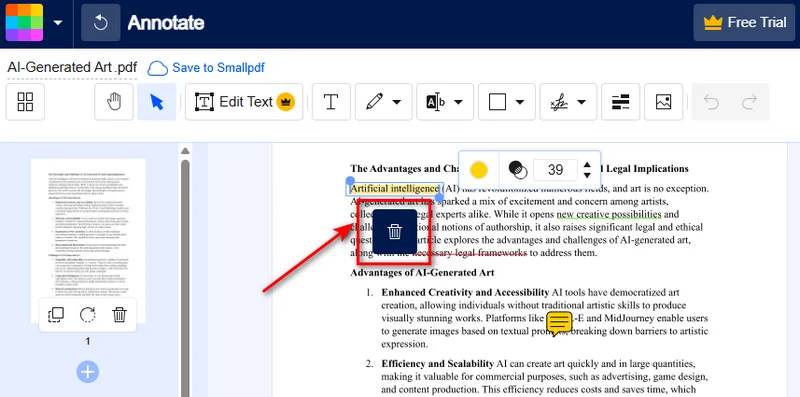
While online tools are free and convenient, keep two things in mind: First, avoid uploading PDFs with sensitive financial data or trade secrets to third-party servers. Second, most web tools require you to delete comments one by one. If your document has dozens of notes or contains confidential data, try Adobe Acrobat or the Python method below.
How to Remove Annotations from PDF Automatically with Python
For developers or users who need to process multiple PDFs regularly, automation can save significant time compared with manual editing. If you need to automate document workflows or process large batches of files, you can remove all comments from PDF documents using a Python script.
In official PDF specifications, interactive elements like sticky notes, text markups, and shapes are technically called "annotations." Using the Free Spire.PDF for Python library, you can easily clear these elements out of the file structure automatically. As a standalone component, it allows you to process PDF files locally without relying on Adobe Acrobat, which is useful for automated batch processing.
Python Code to Clear PDF Comments
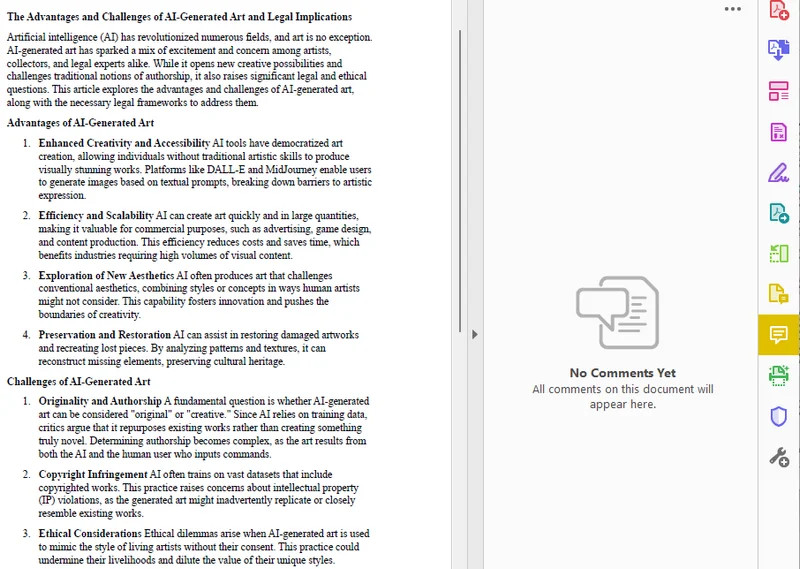
With the help of Free Spire.PDF, we can delete annotations from PDFs with two main steps: loop through each PDF page, access the annotation collection of each page and remove all annotation objects.
Here's the code example:
from spire.pdf.common import *
from spire.pdf import *

# Load the target PDF document from your local directory
pdf = PdfDocument()
pdf.LoadFromFile("/input/sample.pdf")

# Loop through all pages to remove all comments from pdf
for i in range(pdf.Pages.Count):
    page = pdf.Pages.get_Item(i)

    # Clear all sticky notes, highlights, and annotations on the current page
    page.AnnotationsWidget.Clear()

# Save the clean PDF
pdf.SaveToFile("/output/commentremoved.pdf")
pdf.Close()
FAQs about Removing Comments from PDF
Q1: How to remove comments from a PDF document for free?
A: You can use free web tools like Smallpdf to upload, clean, and download your file in seconds. However, if security is your top priority, using the Free Spire.PDF library is a better alternative. It runs entirely offline on your local machine, allowing you to batch-clean confidential documents for free with zero data leak risks.
Q2: Will removing comments also delete the highlight effect in the PDF?
A: Yes. In PDFs, highlights, underlines, and strikethroughs are classified as text markup annotations. When you remove annotations from PDF via Adobe's Sanitize tool, online editors, or Python scripts, these visual highlights will be deleted along with the sticky notes.
Q3: How do I hide comments instead of deleting them in Adobe?
A: If you want to keep the feedback for later but need a clean view right now, you can open the Comment pane in Adobe Acrobat and click the Hide All Comments icon at the top of the panel.
Conclusion
Knowing how to remove comments from PDF files helps you prepare clean and professional documents before sharing them. Whether you use Adobe Acrobat, an online PDF editor, or a Python script with Free Spire.PDF, you can easily delete comments based on your specific needs. Choose Adobe Acrobat for detailed manual editing, online tools for quick one-time tasks, or Python automation when you need to process multiple PDF files efficiently.
Also Read:
How to Add a Watermark in PowerPoint (Detailed Guide)
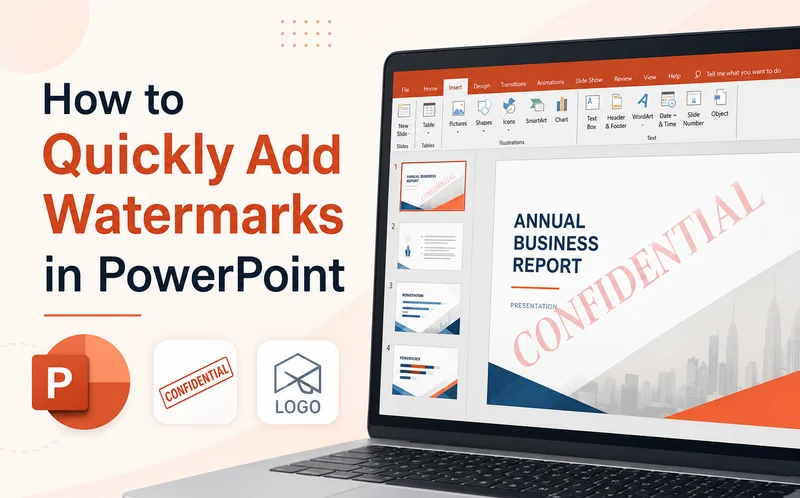
When creating presentations, adding watermarks, such as a company logo, slogan, or "CONFIDENTIAL" label, is an effective way to maintain a consistent design and indicate document ownership. However, because PowerPoint does not have a built-in, one-click watermark button, many users are unsure about how to add a watermark in PowerPoint presentations.
This guide walks you through several practical ways to add watermarks in PowerPoint, from manual Microsoft PowerPoint workarounds to batch processing with Python automation, helping you create secure and professional presentations easily.
- Insert Watermark in PowerPoint via Slide Master
- Put Watermark in PPT via Slide Master Code
- Add a Watermark in PowerPoint Slides Individually
- Best Practices
- FAQs
How to Insert Watermark in PowerPoint via Slide Master
Since MS PowerPoint lacks a watermark tool, the most effective way is to manually add text or image watermarks directly into the Slide Master. This applies the watermark to every slide automatically, saving time and keeping your formatting consistent across the entire presentation.
Step-by-Step Guide
- Step 1: Open your presentation and navigate to View > Slide Master on the top ribbon.
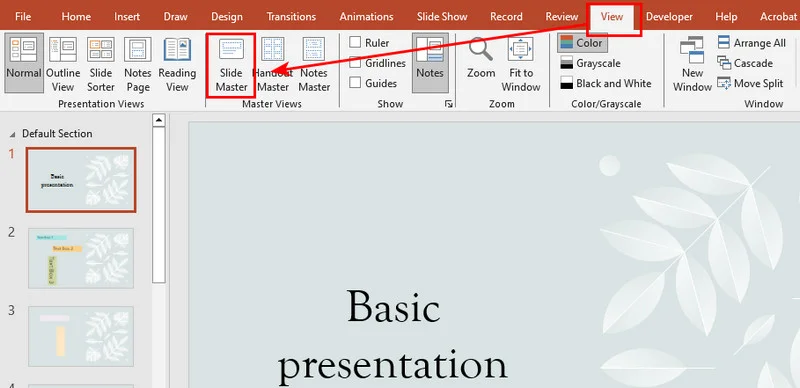
- Step 2: Scroll to the very top of the left thumbnail pane and click the primary slide master (the largest, top-most thumbnail).
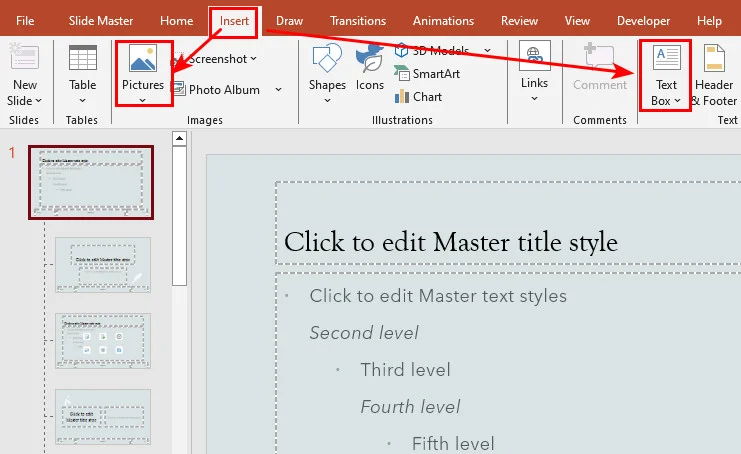
- Step 3: Go to the Insert tab. Choose Text Box for a text watermark (e.g., "CONFIDENTIAL") or click Pictures to upload a low-opacity PNG logo.
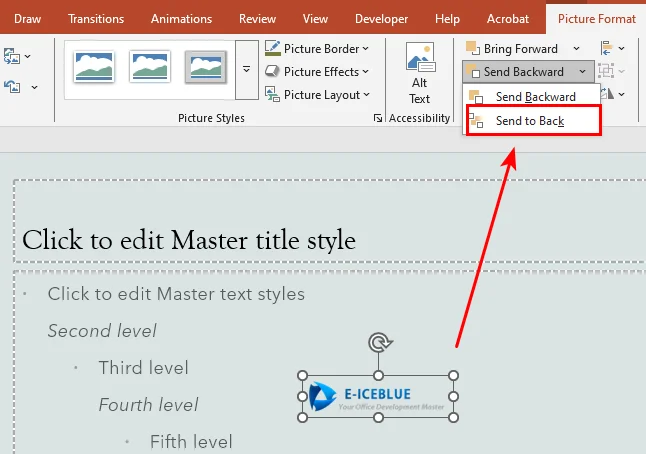
- Step 4: Right-click your inserted text or image and select Send to Back. This keeps your watermark underneath the main presentation data.
- Step 5: Click Close Master View in the Slide Master tab to return to the normal editing mode.
While this manual approach is perfect for one-off design tasks because it is highly visual and requires no technical background, it becomes inefficient when it comes to multiple presentations. Relying on repetitive manual work leaves too much room for human error. To handle large-scale document formatting effectively, we should turn to programmatic automation.
How to Put Watermark in PPT via Slide Master Code
When dealing with a large batch of PowerPoint files, automating the workflow with code is the more efficient choice. In this section, we will demonstrate how to automatically add watermarks in PowerPoint presentations using Free Spire.Presentation for Python. It is a free, standalone library that enables users to create and edit presentations without requiring Microsoft PowerPoint to be installed.
With the help of Free Spire.Presentation, we can still put watermarks in PPT by inserting an image or text into the Slide Master to apply the watermark across the entire presentation.
Here is the code example:
from spire.presentation.common import *
from spire.presentation import *

# Initialize and load the PPT file
presentation = Presentation()
presentation.LoadFromFile("/input/pre1.pptx")

# Get the slide master of the first slide
master = presentation.Masters[0]

# Calculate the coordinates to center the watermark image
img_width = 350.0
img_height = 110.0
left = (presentation.SlideSize.Size.Width - img_width) / 2
top = (presentation.SlideSize.Size.Height - img_height) / 2

# Define the coordinates using RectangleF class
rect = RectangleF(left, top, img_width, img_height)

# Add the image shape to the slide master as a watermark
image_shape = master.Shapes.AppendEmbedImageByPath(ShapeType.Rectangle, "/Logo1.png", rect)

# Optimize appearance and send the shape to the background
image_shape.Line.FillType = FillFormatType.none
image_shape.SetShapeArrange(ShapeArrange.SendToBack)

# Save the presentation
presentation.SaveToFile("/output/MasterImageWatermark.pptx", FileFormat.Pptx2010)
presentation.Dispose()
Here's the preview of the output PowerPoint presentation:
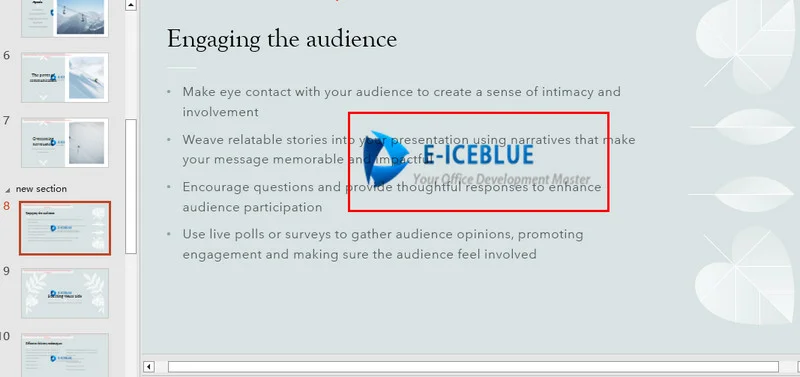
As seen in the left thumbnails, the same image watermark is now applied across all slides.
How to Add a Watermark in PowerPoint Slides Individually
While creating watermarks in Slide Master is ideal for protecting the full document, certain scenarios require a more precise way. For instance, you might want to stamp a "CONFIDENTIAL" text watermark only on specific content slides while leaving the cover page and closing slide clean and clear.
Adding a watermark to a specific slide is largely the same as the slide master method. You still insert rectangle shapes and add text or images. The only difference is that you use the presentation.Slides[index] property to target the specific slide instead of the global template.
Here is how to apply both text and image watermarks to the 8th slide:
from spire.presentation.common import *
from spire.presentation import *

# Initialize and load the PPT file
presentation = Presentation()
presentation.LoadFromFile("/input/pre1.pptx")

# Get presentation dimensions and target the 8th slide
slide_size = presentation.SlideSize.Size
first_slide = presentation.Slides[7]

# Load the image file stream
stream = Stream("/Logo1.png")
image = presentation.Images.AppendStream(stream)
stream.Close()

# Get the original width and height of the image
img_width = float(image.Width)
img_height = float(image.Height)

# Calculate the coordinates to center the image and define the bounding rectangle
img_left = (slide_size.Width - img_width) / 2
img_top = (slide_size.Height - img_height) / 2
img_rect = RectangleF(img_left, img_top, img_width, img_height)

# Add a rectangle shape and fill it with the image
img_shape = first_slide.Shapes.AppendShape(ShapeType.Rectangle, img_rect)
img_shape.Line.FillType = FillFormatType.none
img_shape.Locking.SelectionProtection = True  # Enable selection lock to prevent accidental modification
img_shape.Fill.FillType = FillFormatType.Picture
img_shape.Fill.PictureFill.FillType = PictureFillType.Stretch
img_shape.Fill.PictureFill.Picture.EmbedImage = image


# Define the width, height, and centering coordinates for the text watermark
txt_width = 350.0
txt_height = 110.0
txt_left = (slide_size.Width - txt_width) / 2
txt_top = (slide_size.Height - txt_height) / 2
txt_rect = RectangleF(txt_left, txt_top, txt_width, txt_height)

# Add a rectangle shape container for the text
txt_shape = first_slide.Shapes.AppendShape(ShapeType.Rectangle, txt_rect)
txt_shape.Fill.FillType = FillFormatType.none
txt_shape.ShapeStyle.LineColor.Color = Color.get_Transparent()
txt_shape.Line.FillType = FillFormatType.none
txt_shape.Rotation = -35                     # Rotate the text by -35 degrees
txt_shape.Locking.SelectionProtection = True  # Enable selection lock to prevent accidental modification

# Configure the watermark text content and formatting
txt_shape.TextFrame.Text = "CONFIDENTIAL"
text_range = txt_shape.TextFrame.TextRange
text_range.Fill.FillType = FillFormatType.Solid
text_range.Fill.SolidColor.Color = Color.FromArgb(120, Color.get_Black().R, Color.get_HotPink().G, Color.get_HotPink().B)
text_range.FontHeight = 45
text_range.LatinFont = TextFont("Times New Roman")

# Send both the image and text shapes to the background layer to prevent blocking content
img_shape.SetShapeArrange(ShapeArrange.SendToBack)
txt_shape.SetShapeArrange(ShapeArrange.SendToBack)

# Save the presentation file
presentation.SaveToFile("/output/WatermarkinSpecificSlide.pptx", FileFormat.Pptx2013)
presentation.Dispose()
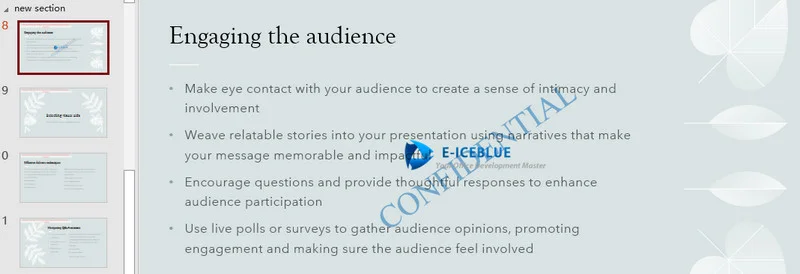
The Selection Lock Hack
Because these shapes are added directly onto the main slide canvas rather than the Slide Master, users could technically click and move them. To prevent this, setting shape.Locking.SelectionProtection = True on both the image and text shapes acts as an additional safeguard. It helps prevent accidental editing.
You may like: 5 Effective Ways to Password Protect PowerPoint Files
Best Practices
Before running scripts or sharing PowerPoint presentations, keep these design principles in mind to keep your presentation clean and easy-to-read:
- Transparency is Key: 15% to 20% opacity level is recommended. The watermark should not cover the main text.
- Strategic Rotation: Tilt your text at a -35° or -45° angle. Diagonal text blocks make unauthorized smartphone screenshots or photo leaks much harder to crop out.
- Color Selection: Neutral colors are suggested. Use light grays for light slide backgrounds and deep slate tones for dark presentation themes. Avoid loud, high-contrast colors like pure red or black.
Conclusion
Adding watermarks to your PowerPoint presentations protects your brand and secures sensitive data. For a quick, one-off file, the manual Slide Master view works perfectly. However, Python automation is better suited for large-scale processing. By utilizing Free Spire.Presentation for Python, you can easily script both global master updates and page-specific locks without even needing Microsoft PowerPoint installed. Pick the method that fits your current need and start securing your presentations today.
FAQs about Adding Watermarks to PPT
Q1: Can users remove the Python-generated watermark?
Not during regular editing. A watermark added via the Slide Master is natively unclickable in the standard view. However, users can still open the Slide Master view to move or delete it manually. If you want absolute, unremovable security, export the presentation to a PDF.
Q2: Why does my watermark image look pixelated?
The source image resolution is too low. Whether adding it manually or via code, always use a high-resolution PNG file with a transparent background.
Q3: Will the watermark remain intact when printing the slides?
Yes. Watermarks are embedded directly onto the slide master or locked canvas coordinates. They will generally preserve the opacity and the position when printing and exporting.
Also Read:
Convert EPUB to Word DOCX in 3 Simple Ways [Ultimate Guide]
EPUB is ideal for reading eBooks, but it's not designed for editing. If you want to revise content, quote a chapter, or reuse text in Microsoft Word, you'll first need to convert EPUB to Word, as Word doesn't support EPUB files natively. Fortunately, there are several ways to do this. Depending on whether you need a quick online converter, a desktop application, or an automated batch solution, this guide walks you through three practical methods using online tools, Calibre, and Python.
- Convert EPUB to Word Online Quickly
- Convert EPUB to DOCX Offline with Calibre Safely
- Batch Convert EPUB to Word Using Python
- Which Method Should You Choose
- FAQs
Convert EPUB to Word Online Quickly
If you only have one or two short eBooks to convert, online EPUB-to-Word converters are ideal for users who only need occasional conversions right in their web browser.
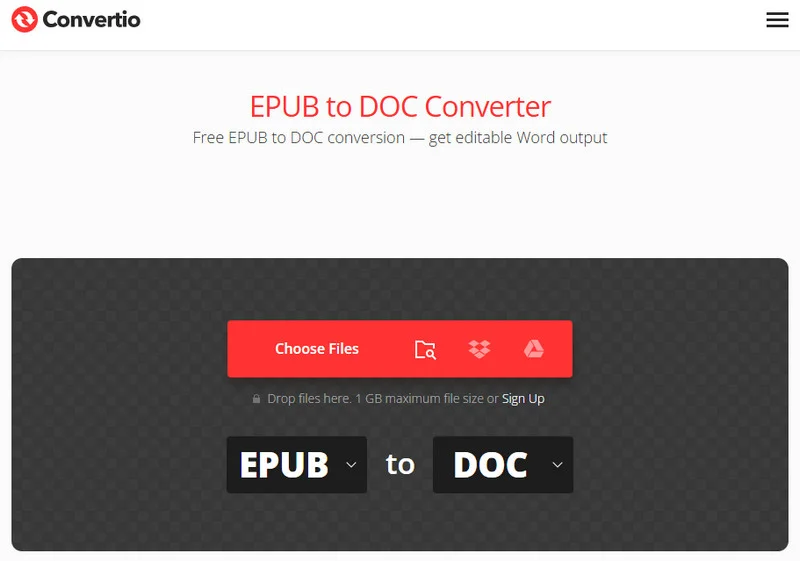
Two of the most reliable web-based platforms for this task are Convertio and FreeConvert. Convertio offers an easy-to-use interface and outputs clean .docx files, though it caps free uploads at 100MB. FreeConvert, on the other hand, allows larger files and gives you advanced control over individual conversion settings.
Tip: If you just want to view or share an eBook rather than edit its contents, converting it to PDF may be a better choice. See our guide on how to convert EPUB to PDF for several quick and reliable methods.
Steps to convert EPUB to Word documents with online tools
- Step 1: Upload EPUB files onto the website's dashboard.
- Step 2: Choose DOCX or DOC as your target format.
- Step 3: Click the convert button and wait for the cloud server to process documents.
- Step 4: Save the converted Word document directly to your device.
Pros and Cons
- Pros: No installation required; completely free and fast for single files.
- Cons: Potential privacy risks since you upload files to a third-party server; strict file size limits; unstable formatting if the book has a complex layout.
When it comes to sensitive data or confidential company materials, you might want to skip the web apps to avoid privacy risks. Instead, let's look at how to convert from EPUB to Word using a private, desktop-based workflow.
Convert EPUB to DOCX Offline with Calibre Safely
When web tools fail to handle heavy books or complex styling, you can turn to Calibre. Calibre is an open-source ebook management tool that also supports format conversion.
Because it runs completely on your local machine, your data remains 100% private. It features a robust layout engine that analyzes the underlying code of an eBook, making it an incredibly accurate tool to convert EPUB content into DOCX while preserving most of the original formatting.
Step-by-Step Desktop Guide
- Step 1: Open Calibre and click the Add books button in the top-left corner to load your EPUB file.
- Step 2: Highlight your book from the main library list and click the Convert books icon on the top toolbar.
- Step 3: In the pop-up window, look at the top-right corner and change the Output format to DOCX.
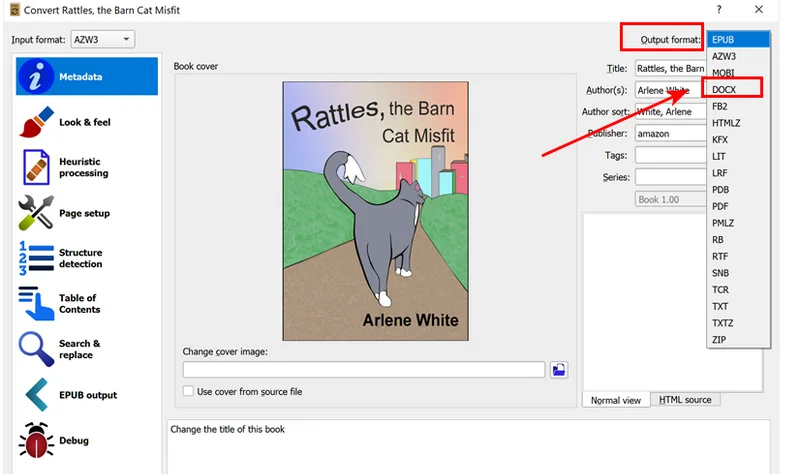
- Step 4: On the left-hand menu, navigate to Heuristic Processing and check the box to enable heuristic processing. This built-in feature automatically scans and fixes broken paragraph lines, unwanted hyphenations, and bad spacing.
- Step 5: Click OK at the bottom right. Once the tasks spinner hits zero, click Save to disk to export your polished Word document.
Tip:
If you prefer using your terminal over a user interface, Calibre installs a native command-line utility straight into your system path. Open your terminal or PowerShell and run this command to instantly convert an EPUB file:
ebook-convert input.epub output.docx
While Calibre is excellent for manual management, it still requires many clicks or custom shell scripts. If you are integrating EPUB conversion into your own application or need to automate massive EPUB files, writing a custom Python script is more efficient.
Batch Convert EPUB to Word Using Python
Manually clicking buttons on web pages or desktop apps becomes inefficient when you have hundreds of eBooks that need to be converted. For developers and IT professionals, building a script to convert EPUB files to Word docs in large batches saves hours of repetitive labor.
To automate the conversion process, we'll use Free Spire.Doc for Python. The library provides native support for EPUB documents and can be integrated into Python applications for automated document conversion. It also supports converting Word documents back to EPUB, making it a practical choice for two-way document conversion.
Python Code Implementation
Converting a single file with Free Spire.Doc takes just two steps: loading the EPUB and saving it as a DOCX. However, to handle an entire library, we need a quick Python loop to scan the directory.
Before running the script, make sure you install the library in your environment:
pip install Spire.Doc.Free
The following example converts every EPUB file in a folder into DOCX:
import os
from spire.doc import Document, FileFormat

# Define source and destination directories
input_dir = "/input/epub/"
output_dir = "/output/epubtoword/"

# Ensure the output directory exists
if not os.path.exists(output_dir):
    os.makedirs(output_dir)

# Scan the folder and batch convert all EPUB files
for file_name in os.listdir(input_dir):
    if file_name.lower().endswith('.epub'):
        # Create a Document object
        document = Document()

        # Load the EPUB file natively
        document.LoadFromFile(os.path.join(input_dir, file_name))

        # Save the EPUB document as a Word DOCX file
        base_name = os.path.splitext(file_name)[0]
        document.SaveToFile(os.path.join(output_dir, f"{base_name}.docx"), FileFormat.Docx)

        # Close the document to release resources
        document.Close()
Here's the preview of the batch-converted Word documents: 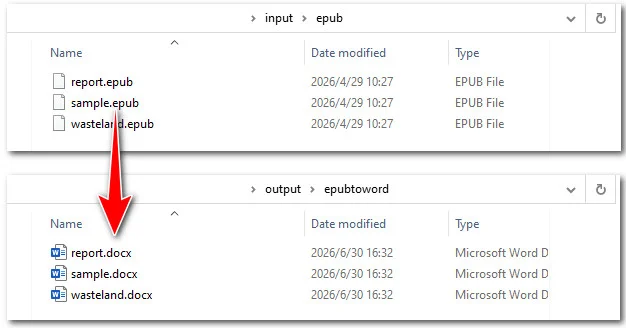
You may like: 5 Best EPUB to TXT Converters (Online & Programming Ways)
Which Method Should You Choose?
Picking the perfect tool depends on how many files you have, your technical background, and your privacy standards. Here is a clear breakdown to help you decide which approach to take:
| Feature / Metric | Online Tools | Calibre | Python Automation |
|---|---|---|---|
| Target Audience | Casual users with quick tasks | Heavy readers and book collectors | Developers and system administrators |
| Data Privacy | Low | High | High |
| File Size Limit | Yes | None | None |
| Batch Processing | Average | Good | Best |
| Layout Retention | Average | Very Good | Excellent |
Conclusion
Choosing the right solution comes down to your workload. If you just have one or two public files and want a quick fix without installing anything, online converters like Convertio are great. For a larger personal file where you need privacy and complex layout control, Calibre is a better choice. Finally, if you need to handle bulk conversions or integrate it into a background workflow, using a Python script with Free Spire.Doc is the best option.
FAQs about Converting EPUB to Word Documents
Q1: Why did my converted Word document lose its formatting or images?
Because EPUBs use flexible web layouts while Word relies on fixed page dimensions, their formatting rules don't always match. When complex elements like sidebars are converted, Word often cannot map their exact positions, so it deletes them or pushes them to a new page. To improve the conversion results, enable Calibre's heuristic processing before exporting or adjust Free Spire.Doc script to handle specific element margins.
Q2: Can I convert DRM-protected EPUB files to Word?
DRM-protected EPUB files cannot be converted directly. If permitted by the publisher and applicable local laws, remove the DRM protection before converting the file.
Q3: Is it possible to convert from EPUB to Word without losing the clickable Table of Contents (TOC)?
Yes! Advanced utilities like Calibre and Free Spire.Doc automatically translate the native eBook compilation index into Word's default interactive hyperlink system.
Also Read:
The Ultimate Guide to Convert Text File to Excel (5 Simple Ways)
Table of Contents
- Convert TXT to Excel by Importing Data with Data Tab
- Open TXT File in Excel Directly and Save It
- Convert Selected Text Snippets with Text to Columns
- Batch Convert TXT to Excel with Python Script
- Convert Text Files to Excel Fast with Online Converter
- The Comparison Table of the 5 Methods
- Troubleshooting
- FAQs
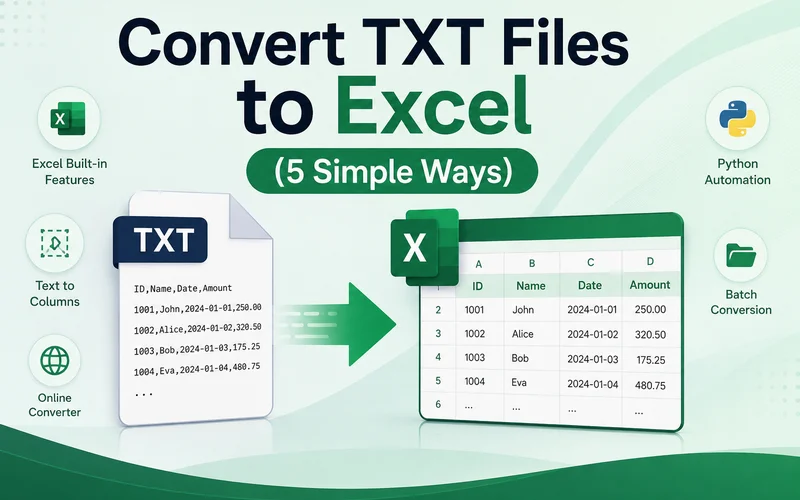
Many systems export reports, logs, and transaction records as TXT files. While text files are easy to store and share, analyzing large amounts of data in a plain text format can be frustrating. Sorting, filtering, and creating formulas become difficult, which is why many users need to convert TXT files to Excel for easier data management.
This guide covers five practical ways to convert text files to Excel, including Microsoft Excel's built-in import tools, Python automation solutions and online converters.
- Convert TXT to Excel by Importing Data with Data Tab
- Open TXT File in Excel Directly and Save It
- Convert Selected Text Snippets with Text to Columns
- Batch Convert TXT to Excel with Python Script
- Convert Text Files to Excel Fast with Online Converter
- The Comparison Table of the 5 Methods
- Troubleshooting
- FAQs
Convert TXT to Excel by Importing Data with Data Tab
Let's start with Excel's built-in features. To make data migration across different formats much smoother, Excel offers native tools to import data from various external sources. This approach allows you to import structured data from a TXT file while preserving its original layout. It is a highly reliable way to convert a text file to Excel.
Here are the detailed steps:
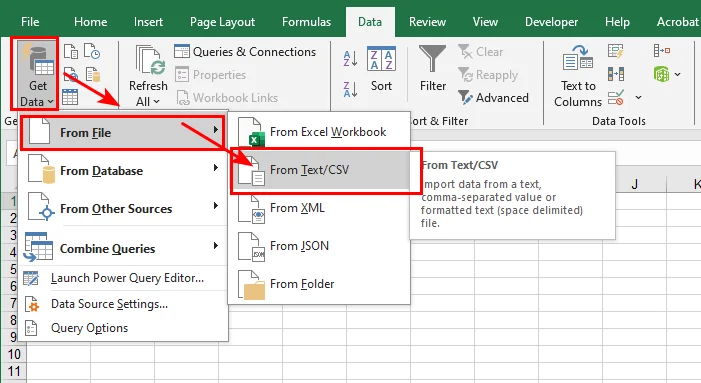
- Step 1: Open Microsoft Excel and navigate to the top menu bar, click the Data tab, select Get Data > From File, and then click From Text/CSV.
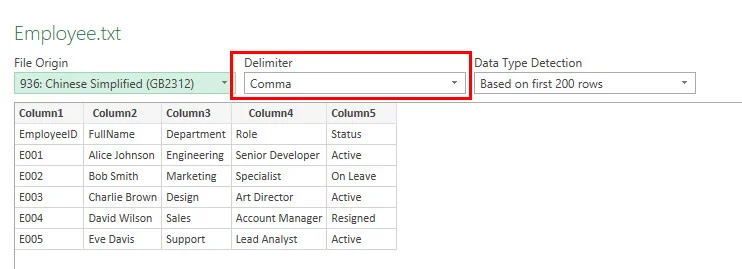
- Step 2: Click the Delimiter dropdown menu to verify if your data splits correctly using a comma, tab, space, or semicolon.
- Step 3: Review the columns in the preview grid, click the Load button at the bottom right, and save the document.
Notice: If your text contains non-English characters or symbols that look scrambled in the preview window, click the File Origin dropdown menu and change the encoding to UTF-8 or GBK to fix the display before loading.
- Pros: High accuracy, prevents messy codes, and handles huge files flawlessly.
- Cons: Takes a few more clicks than other methods.
Open TXT File in Excel Directly and Save It
If your dataset is straightforward and uses clear delimiters, you can pull the raw document straight into the application. Open the text file directly in Excel and let the built-in import wizard automatically split the data into columns. This is the quickest method for opening and converting a well-formatted text file.
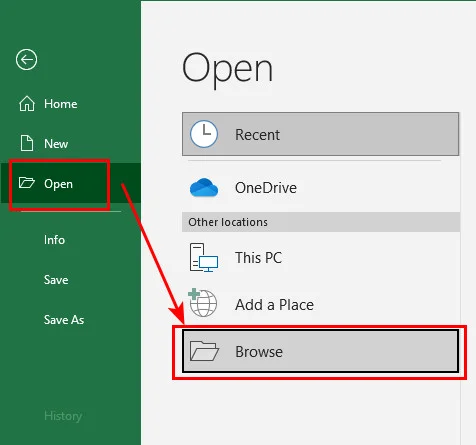
- Step 1: Launch Excel, click File > Open > Browse, and change the file type dropdown filter from "All Excel Files" to All Files (.).
- Step 2: Double-click your TXT file to trigger Excel's built-in data parsing window.
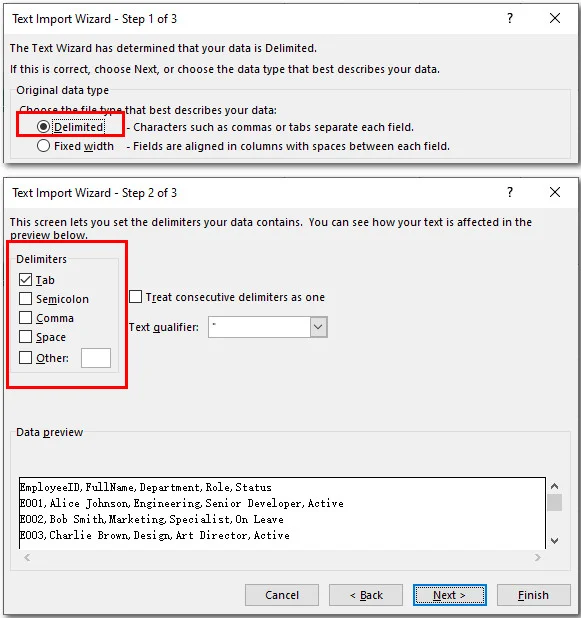
- Step 3: Select Delimited, click next, check the correct separator (like tab or space), and hit Finish.
-
Step 4: Go to File > Save As, choose the target folder, and save it in Excel Workbook (*.xlsx) format.
-
Pros: Fast, requires no preparation.
-
Cons: Risky if the text contains special formatting or complex data types.
Convert Selected Text Snippets with Text to Columns
Sometimes, you don't need to transform an entire report. You might just need a small snippet of data from an email or a system log. In these scenarios, a simple copy-paste lets you insert the exact data you want directly into a single column. Then, you can use the Text to Columns feature to quickly parse that text into separate cells, allowing you to convert a part of the txt file to Excel without dealing with full-scale documents.
- Step 1: Copy the data you need in a text file, and paste it into a cell of a blank Excel sheet.
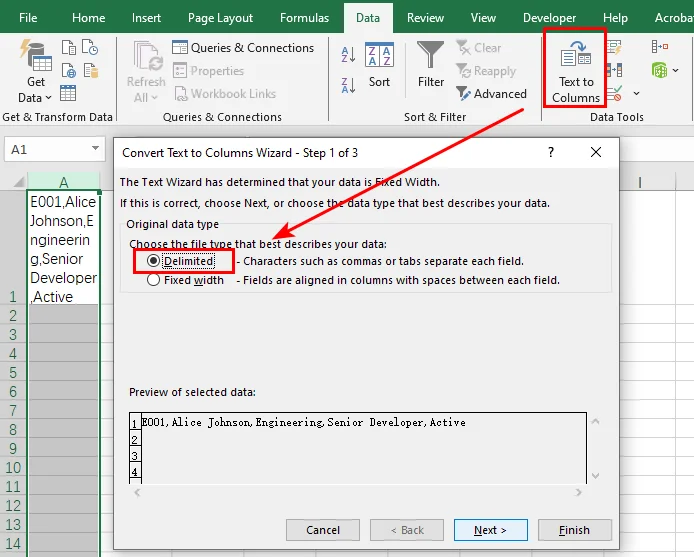
- Step 2: Highlight the whole column, go to the Data tab, and click Text to Columns.
-
Step 3: Choose Delimited on the first screen and hit Next.
-
Step 4: Check the box next to your delimiter (such as a comma or space), click Finish to distribute the text into separate cells, and save the document.
-
Pros: Perfect for quick edits and partial data snippets.
-
Cons: Inefficient for processing large files or multiple documents.
Batch Convert TXT to Excel with Python Script
If you deal with dozens of reports daily, manually processing each file can become time-consuming. Learning how to convert TXT files to Excel using Python lets you build a hands-free automation pipeline. For this task, we will use Free Spire.XLS for Python, a standalone library that allows developers to create, manage, and convert Excel spreadsheets programmatically without requiring Microsoft Excel to be installed. By using its advanced workbook features, you can easily parse text files with custom delimiters and convert them in batches.
Below is the workflow batch converting text documents to Excel spreadsheets using the library:
- Step 1: Define the file paths and set the target delimiter (such as a comma or tab) to handle different text structures.
- Step 2: Loop through the folder to locate all
.txtfiles and dynamically generate the corresponding.xlsxoutput names. - Step 3: Initialize the
Workbookobject and use theLoadFromFilemethod to parse the text data into rows and columns. - Step 4: Call
AutoFitColumns()on the allocated range to make columns fit data length automatically, then save the documents.
Here is how to use Free Spire.XLS to read and convert multiple text files with mixed delimiters into Excel spreadsheets:
import os
from spire.xls import *

# Define input and output directory paths
input_folder = "/input/txt files/"
output_folder = "/output/excel files/"

# Loop through and process all text files in the input folder
for filename in os.listdir(input_folder):
    if filename.endswith(".txt"):
        txt_path = os.path.join(input_folder, filename)
        excel_name = filename.replace(".txt", ".xlsx")
        excel_path = os.path.join(output_folder, excel_name)

        # Read the first line
        with open(txt_path, 'r', encoding='utf-8') as f:
            first_line = f.readline()

        # Dynamically match delimiter: priority given to comma, then space, else default to tab
        current_delimiter = "," if "," in first_line else (" " if " " in first_line else "\t")

        # Initialize workbook and load the text file
        workbook = Workbook()
        workbook.LoadFromFile(txt_path, current_delimiter, 1, 1)

        # Automatically fit columns to make them match the data length
        sheet = workbook.Worksheets[0]
        sheet.AllocatedRange.AutoFitColumns()

        # Save the result as an Excel file
        workbook.SaveToFile(excel_path, ExcelVersion.Version2016)
        workbook.Dispose()
        print(f"Successfully converted ({'Comma' if current_delimiter==',' else 'Space'}): {filename} -> {excel_name}")
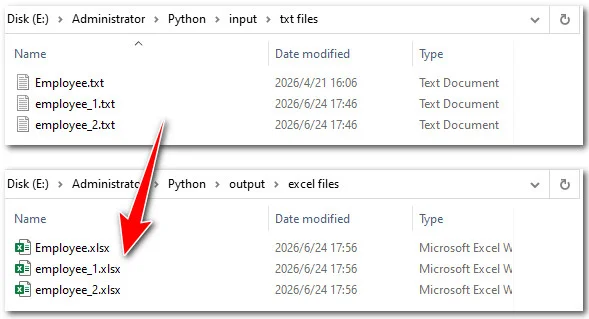
- Pros: 100% automated, processes hundreds of files instantly, handle different files using different delimiters.
- Cons: Requires a Python environment setup on your device.
Convert Text Files to Excel Fast with Online Converter
If you are working on a computer or mobile device without Microsoft Excel installed, online tools provide a quick fix. A web-based TXT-to-Excel converter can save time and effort when you need a fast turnaround.
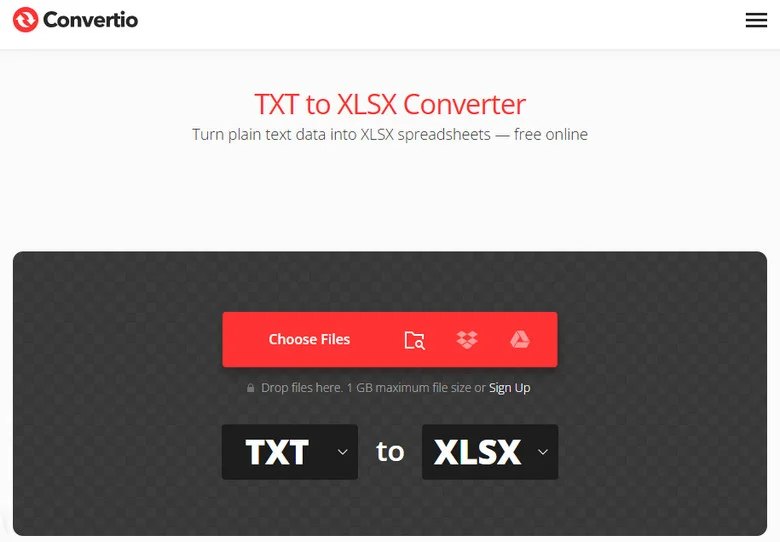
Here is how to convert from text files to Excel using online converters, using Convertio as an example:
- Step 1: Find the TXT-to-XLSX tool of Convertio.
- Step 2: Click to upload the target TXT file from your device.
- Step 3: Click the Convert button, wait a few seconds, and then you can download the resulting Excel file.
- Pros: No software installation required, works on both desktop and mobile devices, and converts files quickly.
- Cons: Limited control over formatting, file size restrictions may apply, and uploading sensitive data to third-party servers can create privacy risks.
The Comparison Table of the 5 Methods
To help you find the best approach, here is a quick comparison table of the 5 methods above based on data size, file complexity, and speed:
| Method | Best For | Data Size Limit | Speed |
|---|---|---|---|
| Data Tab Import | Complex layouts & foreign text | Very High | Medium |
| Direct Open | Clean, basic text files | Medium | Fast |
| Text to Columns | Copying text snippets | Low | Fast |
| Python Code | Batch converting folders | Unlimited | Instant (Automated) |
| Online Converter | Emergency use without Excel | Low | Fast |
Troubleshooting
When learning how to convert a TXT file to Excel, you might encounter minor formatting glitches. Here is how to fix them fast:
Garbled or Scrambled Text
If special symbols or accented characters turn into strange shapes, your file encoding is mismatched. Re-import the file using Method 1 and try switching the File Origin dropdown to Windows-1252 (Western European) or UTF-8 until the text displays correctly in the preview window.
Numbers Turning into Scientific Notation
If long ID numbers appear as 4.5E+11, Excel is automatically formatting them as numeric values. Before importing, set the column type to Text instead of General. If you've already loaded the data, you can still convert those numbers back to text format to preserve the full value.
Conclusion
Converting a TXT file to Excel is easier than most people expect. If you only need to work with a single file, Excel's built-in import tools are usually the quickest option. For larger datasets, they also provide better control over delimiters and encoding. If your accounting software, ERP system, or reporting platform exports daily TXT reports, Python automation can save significant time by processing files in batches. Choose the method that best fits your workflow, and you'll be able to turn raw text data into organized Excel workbooks in just a few minutes.
FAQs about Converting TXT to Excel
Can Excel open TXT files directly?
Yes. Excel can open TXT files directly through File > Open or by using the Data > From Text/CSV import feature. The import method is generally recommended because it provides more control over delimiters, encoding, and column formatting.
Why does my TXT file look garbled in Excel?
This usually happens when the file encoding does not match Excel's import settings. Try re-importing the file and selecting a different encoding, such as UTF-8 or Windows-1252, until the text displays correctly.
How can I convert multiple TXT files to Excel at once?
For batch conversion, automation tools such as Free Spire.XLS for Python are often the most efficient option. A script can process an entire folder of TXT files and save each one as an Excel workbook automatically.
Can I convert TXT to Excel without Microsoft Excel?
Yes. You can use online TXT-to-Excel converters or programmatic solutions such as Python libraries. However, be cautious when uploading files that contain sensitive or confidential information.
Also Read
How to Attach a File to a PDF (Adobe Acrobat & Python Guide)
Imagine sending an invoice PDF to a client but forgetting to include the Excel itemization sheet. Or worse, emailing a technical report without the source code. Merging everything into one place can prevent such mistakes. Knowing how to attach a file to a PDF ensures your readers get all the data they need in a single document. In this guide, you will learn how to add attachments to PDF files with Adobe and how to automate it using Python.
- Understanding the 2 Ways to Attach Files to a PDF
- Comparison Table
- Attach a File to a PDF Manually using Adobe Acrobat
- Attach Documents to PDF using Free Spire.PDF
- Best Practices & Troubleshooting
Understanding the 2 Ways to Attach Files to a PDF
Before diving into the steps, it's important to understand how PDFs handle embedded files. Depending on your goal, you can choose between a clean, hidden approach or a highly visual one.
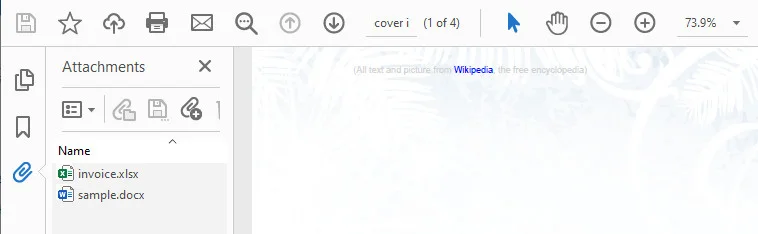
- Document-Level Attachments: Document-level attachments work much like email attachments. The external file is embedded into the PDF document and stays hidden inside the viewer's sidebar panel. This method is ideal for bundling large datasets, source code packages, or supporting documents.
Tip: If you need to package multiple related files into a single PDF container, you may also consider creating a PDF Portfolio, which provides a more structured way to organize attachments.
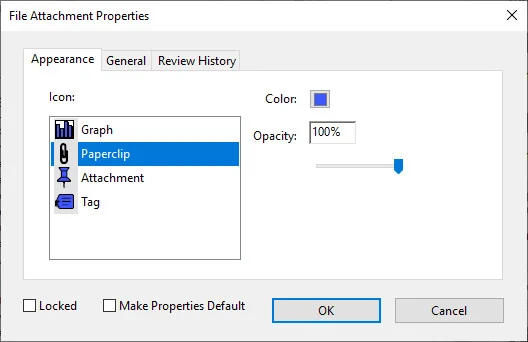
- File Attachment Annotations: These are page-level attachments. They display a visual icon (like a paperclip or a pin) at a specific coordinate on the page. Readers can double-click the icon to open the file immediately. It is ideal for linking a source document right next to text or a paragraph.
Quick Comparison
Choosing the right method to attach files saves time and improves your reader's experience. Use this quick breakdown to decide which approach fits your project:
| Feature | Document-Level Attachment | File Attachment Annotation |
|---|---|---|
| Visibility | Completely hidden on the page. Only visible in the attachments sidebar. | Displays a clickable icon on a specific page coordinate. |
| User Action | User must open the sidebar panel and scroll through a file list. | User reads a paragraph and double-clicks the icon directly on the page. |
| Primary Use | Archiving raw data, attaching project source code or full Excel sheets. | Contextual references, detailed chart explanations, legal proofs. |
| Recommendation | Best for automated data archiving | Best for interactive reading |
All in all, if you want to bundle raw data without messing up your PDF layout, go with Document-Level. If you want your readers to check a specific source file right after reading a paragraph, annotation is better.
Method 1: How to Attach a File to a PDF Manually using Adobe Acrobat
If you only have a few files to process and prefer an intuitive interface, attaching a file to a PDF manually via Adobe Acrobat is perfect. As one of the most popular PDF editors, Adobe Acrobat makes it easy to add attachments to PDF documents, allowing you to seamlessly embed external files either at the document level or as visual annotations.
Adding a Document-Level Attachment to PDF
- Step 1. Open your target PDF file in Adobe Acrobat.
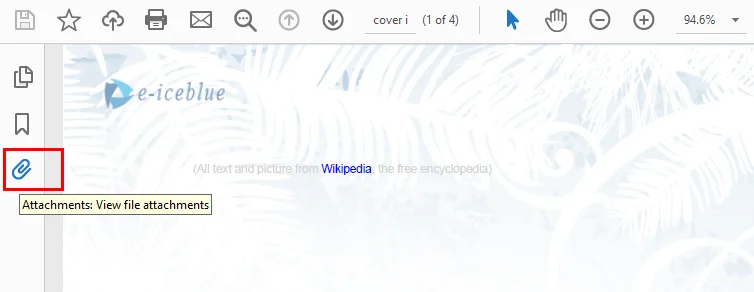
- Step 2. Expand the left navigation pane and click the Attachments icon (it looks like a paperclip).
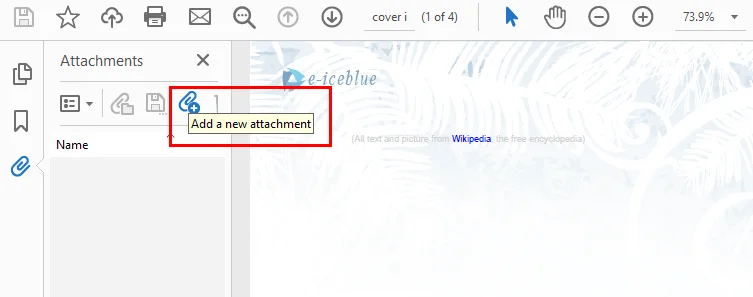
- Step 3. Click the Add files button at the top of the panel, select a file from your computer, and save the PDF.
Adding a File Attachment Annotation in PDF
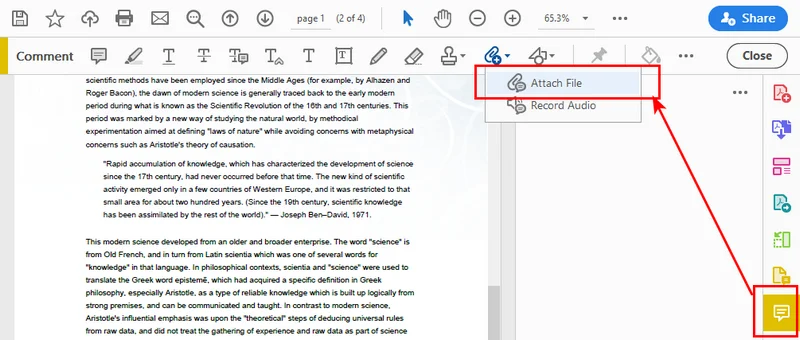
- Step 1: Click Comment in the right sidebar to open the comment toolbar.
- Step 2: Click the Attach File tool on the toolbar.
- Step 3: Click anywhere on the PDF page where you want to place the visual attachment icon.
- Step 4: Select the target file from your device, choose your preferred icon style in the pop-up properties window, and save the document.
Method 2: How to Attach Documents to a PDF Programmatically using Free Spire.PDF
Attaching a few files manually is manageable, but the process quickly becomes inefficient when dealing with dozens or hundreds of documents. If you need to integrate file bundling into an automated enterprise workflow, like linking raw data sheets to invoices or source files to technical reports, doing it by hand is exhausting. To scale your document pipelines, automating file attaching becomes the most efficient and scalable solution. By leveraging Free Spire.PDF for Python, you can achieve this with just a few lines of code.
As a standalone and free community component, Free Spire.PDF for Python requires no Adobe Acrobat installation on your servers. It allows you to manipulate PDF structures seamlessly, supporting both document-level and annotation-style file attaching.
Attach a File to a PDF Directly
This script demonstrates how to inject files directly into the global attachment collection of a PDF. The core idea is to create a PdfAttachment object based on a local file and then use the PdfDocument.Attachments.Add() method to attach it to the source PDF file.
from spire.pdf import *
from spire.pdf.common import *

# Initialize the document object
doc = PdfDocument()

# Load your existing PDF file
doc.LoadFromFile("/input/Booklet.pdf")

# Create document-level attachments by passing the file path
attachment_1 = PdfAttachment("/sample.docx")
attachment_2 = PdfAttachment("/invoice.xlsx")

# Add the attachments to the global attachments collection
doc.Attachments.Add(attachment_1)
doc.Attachments.Add(attachment_2)

# Save the finalized PDF document
doc.SaveToFile("/output/global_attachment.pdf")
doc.Close()
Adding Attachments to a PDF as an Annotation
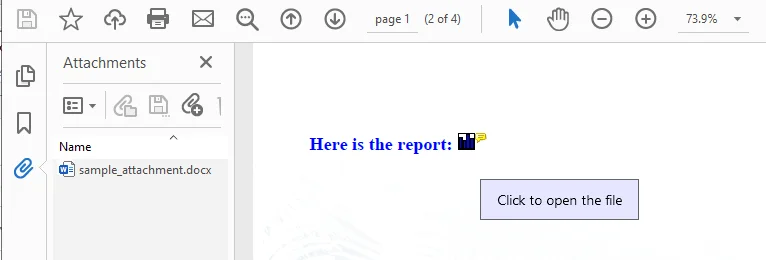
This code sample adds an external file to the PDF as an annotation attachment, which is ultimately displayed as a clickable graph icon on the first page.
The core idea is to retrieve a target page via doc.Pages.get_Item(), define the exact page coordinates using RectangleF, and initialize a PdfAttachmentAnnotation object tied to your external file. After customizing properties like the icon style, color, and hover text, you simply append it to the page's interactive layer using the page.AnnotationsWidget.Add() method.
from spire.pdf import *
from spire.pdf.common import *

# Initialize the document object and load the source PDF file
doc = PdfDocument()
doc.LoadFromFile("/input/new.pdf")

# Get the first page
page = doc.Pages.get_Item(0)

# Draw a text prompt on the PDF page canvas
text_str = "Here is the report:"
font = PdfTrueTypeFont("Times New Roman", 16.0, PdfFontStyle.Bold, True)
x = 50.0
# Calculate the Y coordinate dynamically based on the actual page height
y = doc.Pages.get_Item(0).ActualSize.Height - 300.0
page.Canvas.DrawString(text_str, font, PdfBrushes.get_Blue(), x, y)

# Read the local file into a data stream as the attachment content
data_stream = Stream("/input/sample.docx")

# Calculate position: place the icon 5.0 pixels to the right of the text prompt
text_size = font.MeasureString(text_str)
bounds = RectangleF((x + text_size.Width + 5.0), y, 15.0, 15.0)

# Create the file attachment annotation object
annotation = PdfAttachmentAnnotation(bounds, "sample_attachment.docx", data_stream)

# Customize the appearance and tooltip behavior of the annotation
annotation.Color = PdfRGBColor(Color.get_Blue())
annotation.Flags = PdfAnnotationFlags.Default
annotation.Icon = PdfAttachmentIcon.Graph
annotation.Text = "Click to open the file"

# Add the interactive annotation layer to the page widget collection
page.AnnotationsWidget.Add(annotation)

# Save the PDF document
doc.SaveToFile("/output/AnnotationAttachment1.pdf")
doc.Close()
Note: If you are working on a collaborative review layout, these annotations sync perfectly with standard PDF revision tracking fields.
Best Practices & Troubleshooting when Attaching Files to PDFs
Before you hit send on your newly updated documents, you should keep a few notes in mind to avoid common errors.
- File Size Management: When you attach a file to PDF structures, for example, embedding a 50MB video will make your PDF too large to email. Compress your files first, or use secure cloud URLs for large files.
- Security & Blocked Formats: Modern PDF readers are highly sensitive to malware. It is recommended to attach files in safe formats like
.txt,.docx, or.xlsx. - How to Extract Attachments: What goes in must come out. If you are building an automated pipeline, you can use
PdfAttachment.DataorPdfAttachmentAnnotation.Datato read and extract these files back out into your database later.
Conclusion
In this post, we explored how to attach a file to a PDF using two main approaches: document-level file attachments and page-level annotation attachments. We also explained both manual operations via Adobe Acrobat and code-based automation using Free Spire.PDF for Python.
Whether you need a quick manual fix for a few documents or want to integrate file bundling into an automated workflow, both approaches can help streamline the way you distribute supporting files alongside PDF documents. Choose the method that best fits your business scenario, and start optimizing your PDF pipelines today!
Also Read:
5 Ways to Insert a Page in Word (Manual & Python Automation)
Table of Contents
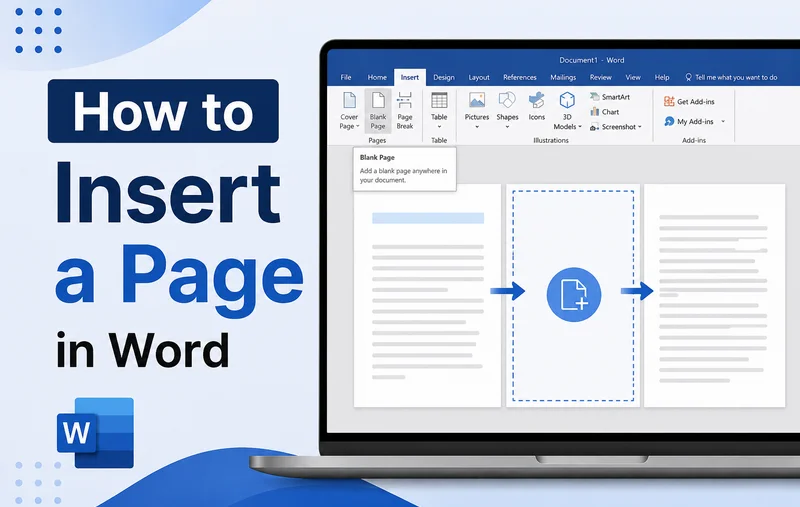
When writing or editing a Word document, we often find ourselves needing to start a fresh page—whether it is right between two existing paragraphs or at the very end of a section. But repeatedly pressing the Enter key is only a temporary workaround; once you edit the content above, the layout can easily shift.
To prevent this layout disorder, you need to know how to insert a page in Word the right way. In this guide, we will walk you through every professional method to seamlessly add a page to your document, including quick shortcuts, automated layout rules, and developers' coding tricks, ensuring your pages split exactly where you intend without unexpected formatting changes.
- Insert a Blank Page in Word Using Toolbar
- Insert a Page in Word Instantly Using Page Break
- Insert a Cover Page in Word Documents
- Automated Page Insertion Using Page Break Before
- Insert a Page in Word Programmatically via Free Spire.Doc
- FAQs
How to Insert a Blank Page in Word Using the Toolbar
If you prefer editing documents using the main menu, the Ribbon is the best method to add a page to a Word file. This approach allows you to split your text exactly where you want, ensuring a smooth and seamless transition to the next page.
Use this option when you want to insert a blank page in Word documents right in the middle of existing content, like creating a fresh, empty canvas for a new section or an upcoming gallery.
- Step 1. Place your cursor exactly where you want the new, empty space to appear.
- Step 2. Go to the Insert tab on the top Ribbon.
- Step 3. Click the Blank Page button in the Pages group.
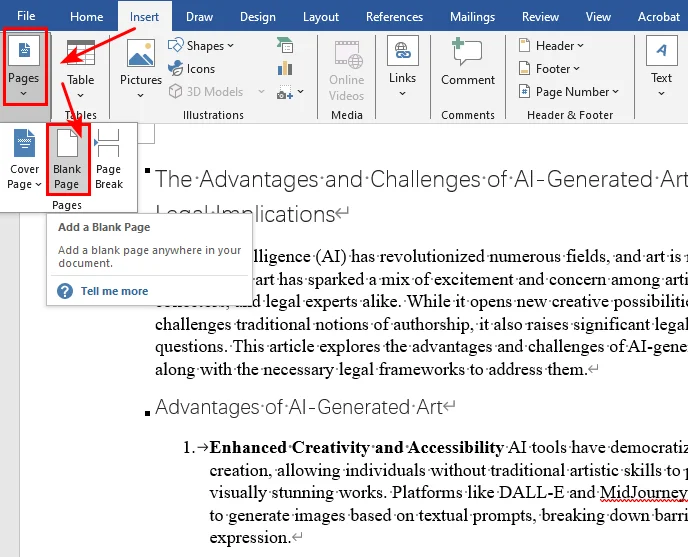
Microsoft Word will instantly insert a clean and empty page into your document at that exact spot, pushing existing text down to the following page.
How to Insert a Page in Word Instantly Using Page Break
Generally speaking, a single page break is used to split your content and push a specific heading or paragraph to the top of the next page. Two consecutive page breaks typically create an empty page between content sections. Whether you prefer using the toolbar or keyboard shortcuts, mastering this method helps you quickly generate blank pages in Word.
Method 1: Shortcut to Insert Page Break
When you are on a tight deadline, using a keyboard shortcut is the fastest way to add a page break to a Word document.
- Step 1. Click to place your cursor right before the text you want to push down.
- Step 2. Press Ctrl + Enter (Windows) or Cmd + Return (Mac) once to push text down, or press it twice if you want to insert a blank page right there.
Method 2: Inserting a Page Break via the Ribbon
If you prefer visual menus, you can achieve the exact same result using Microsoft Word's main navigation bar to add page breaks in Word documents:
- Step 1. Place your cursor right before the text or heading that needs to move.
- Step 2. Navigate to the Insert tab on the Ribbon.
- Step 3. Click Page Break in the Pages group (click it twice if you want to create a full blank page).
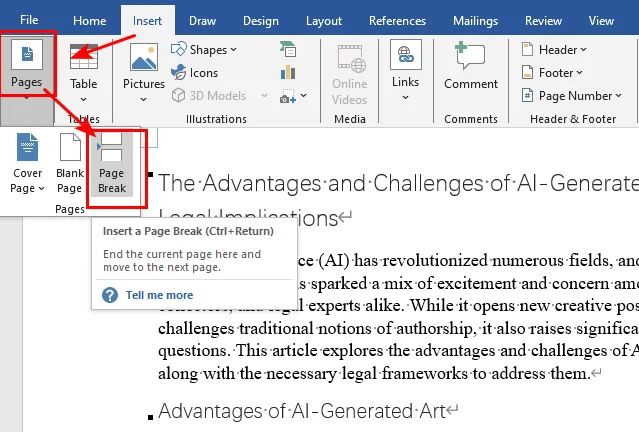
You may like: How to Remove Page Breaks in Word (4 Easy Methods)
How to Insert a Cover Page in Word Documents
Every professional report, business proposal, or academic essay needs a strong front page. Instead of manual formatting, you should let Word handle the design and structural heavy lifting.
If you are looking for how to insert a cover page in Word, the software provides a built-in feature that sets up an introductory layout for you.
- Step 1. Click anywhere inside your document.
- Step 2. Go to the Insert tab on the Ribbon.
- Step 3. Click Cover Page and select your favorite layout from the built-in gallery.
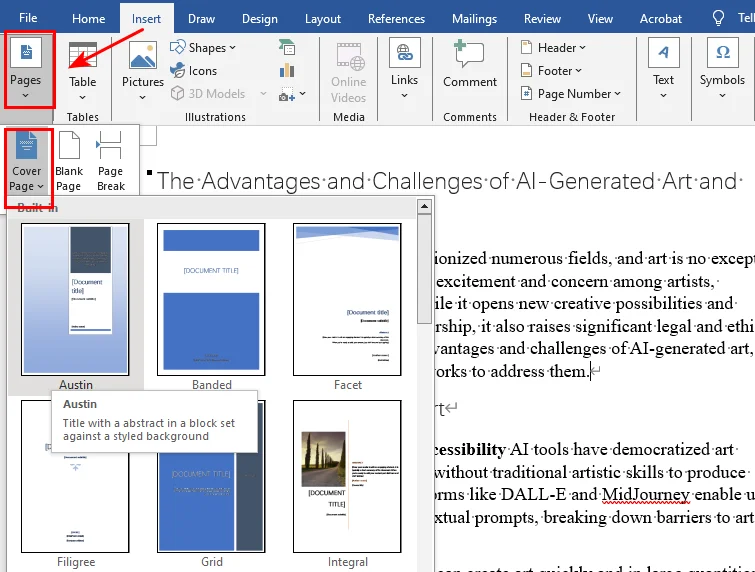
Word handles cover pages differently from regular document content. When you insert a built-in cover page, Word automatically places it at the beginning of the document and can keep page numbering from appearing on the title page.
Automated Page Insertion Using Page Break Before
This feature is especially useful in long reports, manuals, and books where each chapter should start on a new page. Instead of inserting page breaks manually, you can use Word's Page Break Before setting to ensure specific headings always begin on a new page.
- Step 1. Right-click on the specific heading or the Heading 1 style in your Home tab, then select Paragraph.
- Step 2. Go to the Line and Page Breaks tab in the dialogue window.
- Step 3. Check the box next to Page break before, then click OK.
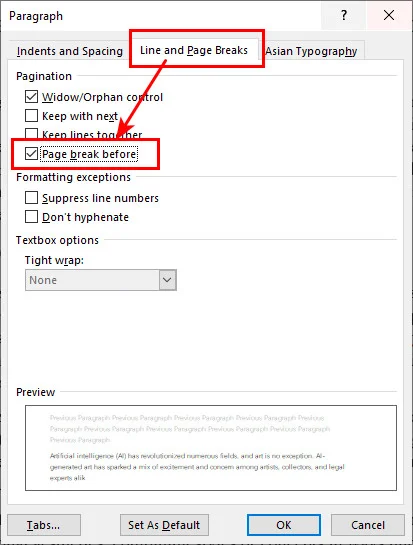
Now, every time you apply that heading style, Word will automatically create a new page for it. Even if you delete paragraphs in earlier sections, your chapters will never crowd together or misalign.
How to Insert a Page in Word Programmatically via Free Spire.Doc
When generating invoices, bundling monthly client statements, or assembling dynamic contracts, it is highly recommended to automate inserting pages in Word documents to save time and effort. Using Free Spire.Doc for Python makes it easy to streamline this entire process. Mirroring the double-break technique we learned in the previous section, this library allows you to add page breaks using the AppendBreak method. By injecting two back-to-back page break objects right into a paragraph or text range, you can effortlessly add an empty page in your output file without opening Microsoft Word.
Here's the code example showing how to insert a new page after the first paragraph:
from spire.doc import *
from spire.doc.common import *

# Create an object of Document class
document = Document()

# Load a sample file from disk
document.LoadFromFile("/input/sample.docx")

# Get the first section of the document
section = document.Sections[0]

# Get the first paragraph
paragraph = section.Paragraphs[0]

# Append the first page break to end the current page
paragraph.AppendBreak(BreakType.PageBreak)

# Append the second page break to create an empty page
paragraph.AppendBreak(BreakType.PageBreak)

# Save the result file
document.SaveToFile("/output/InsertBlankPage.docx", FileFormat.Docx2013)
document.Close()
Below is a preview of the result document, you can see that there's a new page after the first paragraph: 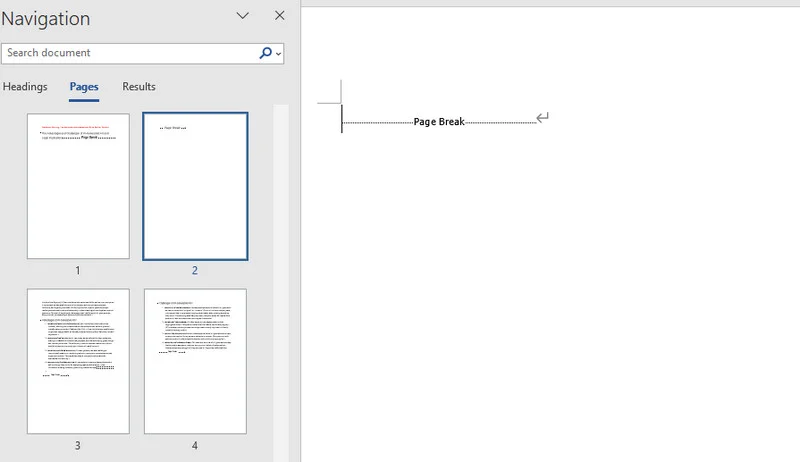
Conclusion
This guide covers five efficient ways to insert a page in Word documents, ranging from quick manual fixes in Microsoft Word to programmatic automation using Free Spire.Doc for Python. Each method shines in different scenarios: manual options like blank pages or page breaks are perfect for one-off edits, while the Free Spire.Doc is the ideal choice for integrating workflows and high-volume file processing. By choosing the appropriate method for your scenario, you can insert pages efficiently while maintaining a consistent document layout.
FAQs about Inserting Pages in Word
Q1: How do I insert a landscape page in Word?
To insert a landscape page in Word, you simply need to isolate that specific section using a section break and change its orientation.
First, place your cursor right before the content you want to flip, go to Layout > Breaks > Next Page, and then navigate to Layout > Orientation > Landscape. This allows you to directly rotate a page in Word from portrait to landscape without changing the formatting of the rest of your document.
Q2: What is the difference between inserting a blank page and a page break?
A blank page drops an untouched empty page between sections. A page break does not create empty space; it is simply an invisible formatting boundary that cuts the current line short and pushes any following text directly to the top of the next page, but inserting two page breaks can also insert a blank page in Word.
Q3: Why does my page numbering mess up after I insert a cover page?
Word's built-in layouts are programmed to hide numbering on title pages, but if numbers still show up on your cover, double-click the header or footer area to reveal the layout options. In the Header & Footer tab on the Ribbon, check the box for Different First Page to start your visible numbering cleanly from page two.
Also Read
How to Count Words in a PDF (The Ultimate Guide for 2026)
Table of Contents
In our daily work and life, we often find ourselves needing to count the words in a PDF document. Unlike Microsoft Word, PDF files do not provide a native word count feature, and most PDF readers offer only limited support for word counting. This is because PDF files treat text as fixed visual elements rather than a continuous flow of words. If you are wondering how to count words in PDF documents easily, you are in the right place. This guide will introduce 3 highly effective solutions to solve this problem, covering everything from simple, direct online tools to automated scripts that can handle hundreds of documents at once.
- Count Words with Online Tools
- Count Words Using Adobe Acrobat and MS Word
- Word Count in PDF with Python
- Methods Comparison
Count Words in PDF with Online Word Counter
When it comes to getting a PDF word count, online counters are usually the first solution that comes to mind. They are incredibly lightweight, require zero installation, and work perfectly across all your devices. Instead of cluttering your computer with heavy software, you can get a quick answer directly inside your web browser and move on to other tasks.
How to do it:
- Step 1. Open your web browser and search for a trusted free online PDF word count tool.
- Step 2. Drag and drop your PDF file directly into the upload box.
- Step 3. After the file is uploaded and processed, the website will display the total word count.
Word count result using an online PDF tool: 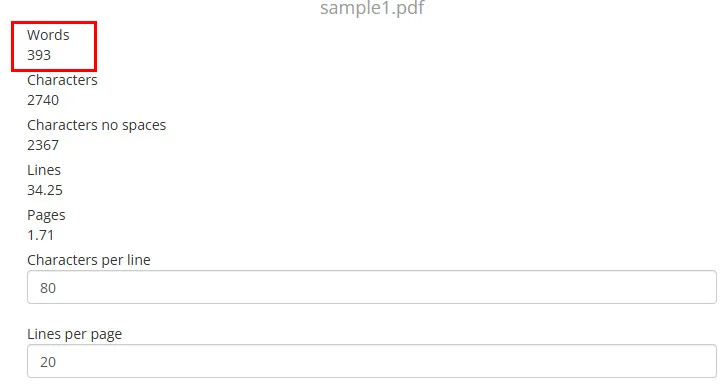
Privacy & Security Warning: It is not recommended to upload sensitive PDFs to free online websites. If your document contains business secrets, personal IDs, or financial data, skip this method entirely. Free tools are only safe for public, non-sensitive articles.
Count Words in a PDF Using Adobe Acrobat and MS Word
If you are working with legal documents, translation projects, or academic papers, accuracy is often more important than speed. In these cases, a desktop-based workflow can be a safer and more reliable choice than relying on online tools.
Unlike Microsoft Word, Adobe Acrobat does not provide a dedicated word count feature in all editions. A common workaround is to convert the PDF to Word and then use Word's built-in feature to check the word count.
Step-by-Step Guide:
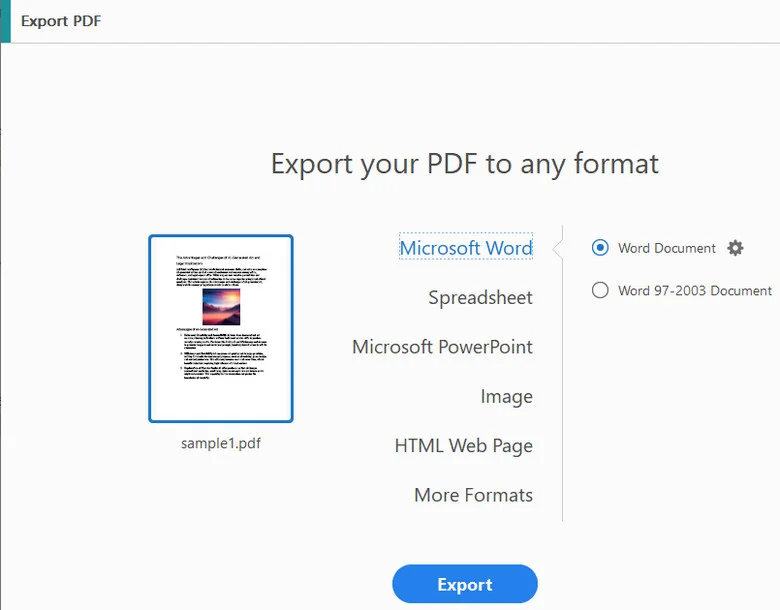
- Step 1. Open your PDF file in Adobe Acrobat (or use the official Adobe Acrobat online converter).
- Step 2. Click Export PDF in the right pane and select Microsoft Word (.docx) as your output format.
- Step 3. Save the newly generated file to your local computer.
- Step 4. Open the document in Microsoft Word, navigate to the Review tab, and click Word Count.
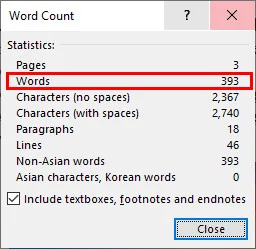
Note: Don't worry about your original file, this process simply creates a brand-new Word document, leaving your original PDF untouched.
How to Do Word Count in PDF with Python Automatically
Manually converting files works fine for one or two documents. But what if you are a developer or a data analyst with a folder full of 500 reports? Manually processing a large number of files can be time-consuming, making automation a more practical solution.
For developers, extracting text programmatically is often the most efficient way to count words in PDF files. You can automate PDF word counting with a short Python script. With the help of Free Spire.PDF for Python, you can extract the raw text programmatically and use regular expressions to count the words instantly.
Python Code Example
The code below shows how to count words of multiple PDF documents in one go:
import os
import re
from spire.pdf.common import *
from spire.pdf import *

# 1. Define the input folder directory
folder_path = "/input/pdfs/"

# 2. Configure text extraction options once
extractOptions = PdfTextExtractOptions()
extractOptions.IsExtractAllText = True

print("--- Word Count Report ---")

# 3. Loop through all files in the directory
for file_name in os.listdir(folder_path):
    # Process only PDF files
    if file_name.lower().endswith('.pdf'):
        file_path = os.path.join(folder_path, file_name)

        # Initialize Document object and load the current PDF
        doc = PdfDocument()
        doc.LoadFromFile(file_path)

        # Extract text from all pages of the current file
        total_text = ""
        for i in range(doc.Pages.Count):
            page = doc.Pages.get_Item(i)
            textExtractor = PdfTextExtractor(page)
            text = textExtractor.ExtractText(extractOptions)
            if text:
                total_text += text + "\n"
        doc.Close()

        # Count English words in the extracted text
        word_count = len(re.findall(r"\b[a-zA-Z]+(?:['-][a-zA-Z]+)*\b", total_text))

        # Print the file name and its corresponding word count
        print(f"File: {file_name} | Word Count: {word_count}")
Below is a preview of the batch word count results printed by the script:

Note: The word count is calculated using regular-expression matching on the extracted text. As different applications use different rules for handling numbers, hyphenated words, punctuation, headers, footers, and other special content, the result may differ slightly from the word count reported by Microsoft Word, Adobe Acrobat, or online PDF word counters.
Why use this?
This method is both fast and secure because your data never leaves your computer. If you are dealing with large-scale projects, utilizing Free Spire.PDF for Python brings several technical advantages over standard open-source tools:
- High-Fidelity Text Extraction: Unlike basic PDF parsers that often scramble text orders or mix up multi-column layouts, it accurately captures text streams based on the visual layout, ensuring your final count is as close to real human reading as possible.
- Excellent Performance on Large Files: It handles massive, multi-page documents smoothly without spending much system memory, thanks to its optimized internal memory release mechanisms.
- All-in-One Extensibility: If your PDF processing workflow grows in the future, you won't need to change tools. It fully supports advanced features like adding annotations, signing documents, or converting file formats under a single, unified codebase.
Just note that if your PDF contains scanned images instead of text, you will need to add an OCR (Optical Character Recognition) step to read the text first.
Which PDF Word Counter Should You Choose?
Choosing the right method depends on your current situation and the type of document you have. Here is a quick breakdown to help you pick the best tool for the job:
| Method | Accuracy | Speed | Privacy Safety | Best For |
|---|---|---|---|---|
| Online Tools | Medium | Fast | Low | Quick, public, and non-sensitive articles |
| Adobe to Word | High | Medium | High (100% Local) | Official docs, legal papers, and highly confidential files |
| Python Script | High | Fast (Bulk) | High (100% Local) | Developers, data analysts, and automated batch processing |
Conclusion
Counting words in PDF files doesn't have to be complicated. Whether you need a quick answer from an online tool, a reliable count through Word conversion, or an automated Python solution for batch processing, there is an option for every scenario. Choose the approach that matches your needs and start analyzing your PDF documents more efficiently.
Also Read
Add Table of Contents to PDF: Adobe, Online Tools & Python
Reading a 100-page PDF document without any navigation can be frustrating and inefficient. Whether it is a business report, e-book, or technical manual, a well-structured table of contents significantly improves navigation. It also helps readers quickly understand the document structure.
However, because PDF is a fixed-layout format, modifying its pages after generation is tricky. This guide introduces the three popular methods to help you add a table of contents to PDF files efficiently with online editors, Adobe Acrobat, and Python.
- Methodology Comparison: Choose Your Approach
- Add a Clickable Table of Contents in PDF Online
- Create a Table of Contents in Adobe PDF
- Add Table of Contents in PDF Automatically via Python
- Tips for Designing a TOC
Methodology Comparison: Choose Your Approach
Before digging into the step-by-step tutorials, you can first get a general overview of the methods introduced in this article. Depending on your current document status and technical background, there is always a solution that fits your needs.
| Method | Best For | Technical Logic | Pros | Cons |
|---|---|---|---|---|
| Online Editors | Completed PDFs, tight deadlines | Reverse Generation: Auto-scans text to create bookmarks, then prints a TOC page. | Incredibly fast; No installation required. | Free tiers have size limits; AI layout errors. |
| Adobe Acrobat Pro | Publisher-grade accuracy, print layouts | Visual Layering: Manual text layout or back-to-source conversion. | Industry standard; Flawless cross-platform links. | Expensive license; High manual labor for long files. |
| Spire.PDF (Code) | Developers, batch server automation | Programmatic Bookmark Generation: Renders fonts via exact X/Y coordinates. | Infinite scaling; 100% automated workflows. | Requires basic programming baseline. |
How to Add a Table of Contents to PDF Online
If you are dealing with a PDF document and need a quick turnaround, web-based tools can be the top choice. Online editors like PDFelement are lightweight and easy to use, allowing you to easily perform various edits directly in your browser simply by uploading your document.
Next, we will demonstrate how to create a clickable table of contents in a PDF using online tools, taking PDFelement as an example.
- Step 1. Go to PDFelement and upload your PDF document.
- Step 2. Navigate to the navigation panel tools and select Auto-Bookmark. The web engine will scan font sizes and line breaks to map out your document's hierarchy.
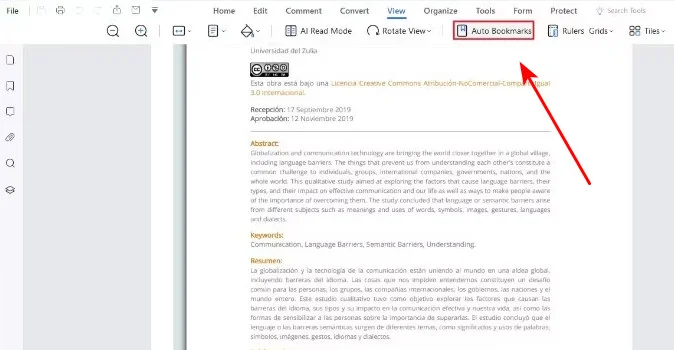
- Step 3. Click on the bookmark options dropdown menu and choose Create Contents Page. The tool will generate a new table of contents page at the beginning of the document.
Note: While online tools are excellent for quick fixes, always review your document after downloading. Complex layouts with floating images can sometimes confuse the auto-detection algorithms, requiring a few manual text tweaks.
How to Create a Clickable Table of Contents in Adobe PDF
Adobe Acrobat is one of the most widely used PDF editors and is commonly used in professional publishing environments. Unlike lightweight web-based tools, it provides advanced editing, compatibility, and document management features. Adobe Acrobat supports both direct PDF editing and document conversion workflows. You can either manually create navigation links inside the PDF or convert the file back to Word to generate a dynamic TOC automatically.
Let’s take a look at how to add a table of contents to a PDF using Adobe Acrobat Pro through these two approaches.
Create a PDF Table of Content in Adobe
Adobe helps you map the content links directly on the PDF canvas using invisible touch targets. Here are the step-by-step instructions.
- Step 1. Open the Organize Pages tool. Click Insert > Blank Page and position it right after your cover sheet to create room for your new index.
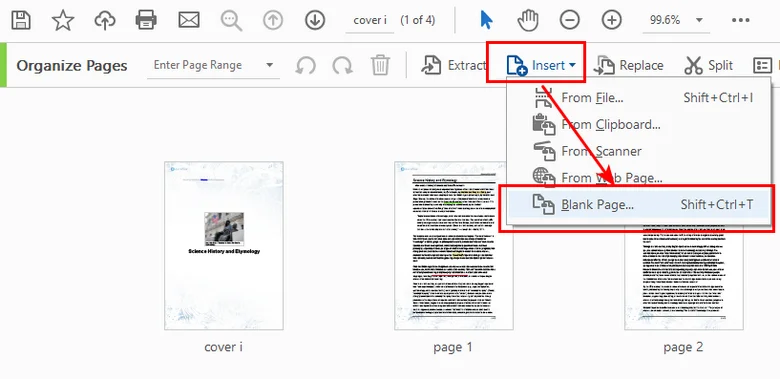
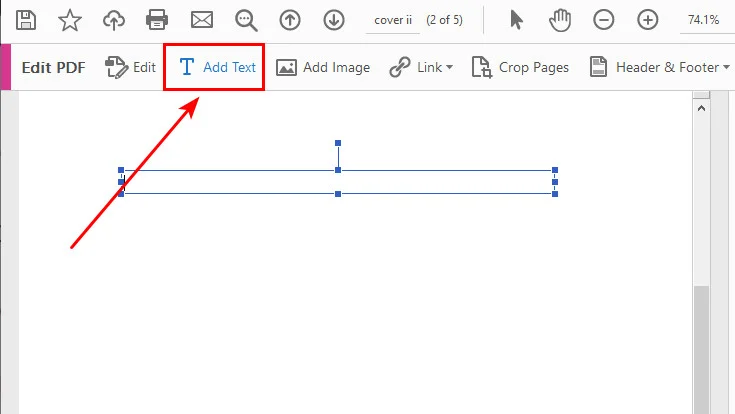
- Step 2. Switch to the Edit PDF tool. Draw a text box on your new blank page and type out your chapter index layout (e.g., Chapter 1: Market Trends .......... Page 4).
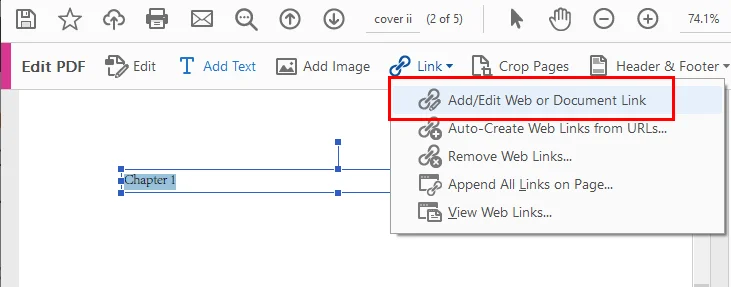
- Step 3. Select the Link tool from the top toolbar, click Add/Edit Web or Document Link, and drag an invisible rectangular box directly over your typed "Chapter 1" text layer.
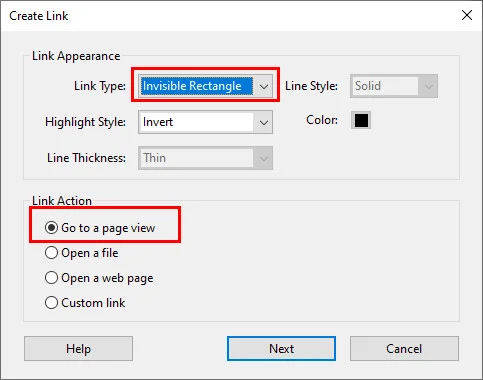
- Step 4. In the pop-up link configuration window, set the link action to Go to a page view. Scroll through your document in the background until Chapter 1 fills your screen nicely, then click Set Link. Repeat this process for the remaining chapters.
Convert back to Word and Add TOC
In addition to building a table of contents directly inside the PDF, you can also convert the file back to a Word document and generate an index. Compared to the former method, this approach requires less manual effort, especially when dealing with long documents.
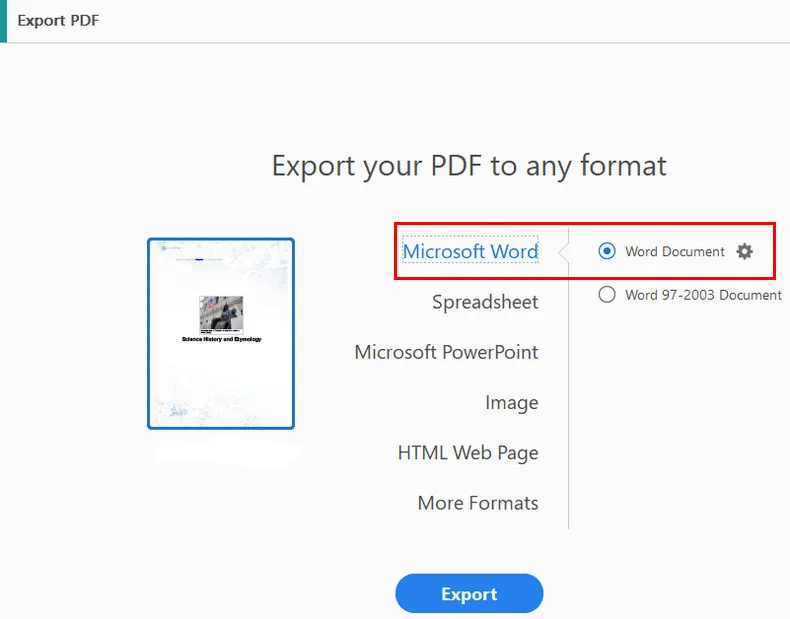
- Step 1: Open your document in Acrobat, navigate to the Export PDF pane, and select Microsoft Word Document.
- Step 2: Open the newly generated Word file, select your section headers, and apply standard Heading 1 / Heading 2 styles from the Home ribbon.
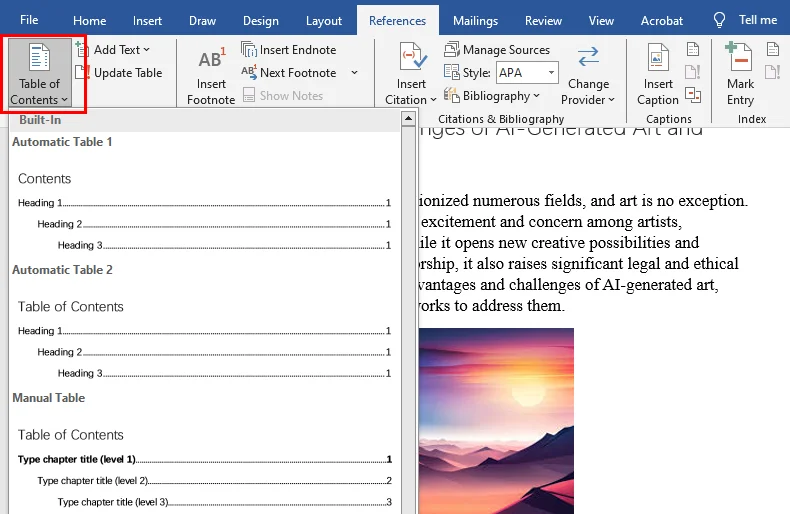
- Step 3: Move your cursor to the first page, go to References > Table of Contents, and drop in a dynamic, native index page.
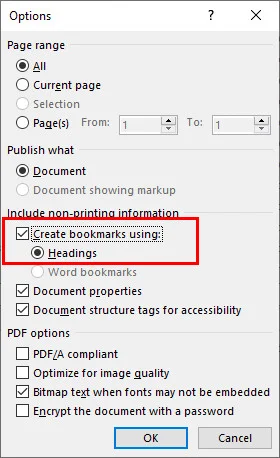
- Step 4: Choose Save As and select PDF. In the save window options, make sure to verify that Create bookmarks using headings is checked to automatically seal your multi-layered navigation.
Also Read: How to Change PDF Page Size: Online, Adobe & With Code
How to Add PDF Navigation Bookmarks Automatically via Python
If you need to process large volumes of reports, invoices, or technical documents automatically, manual methods are often time-consuming. Unlike online tools or Adobe Acrobat workflows, Python libraries can generate bookmarks and navigation structures programmatically, making them ideal for large-scale automation.
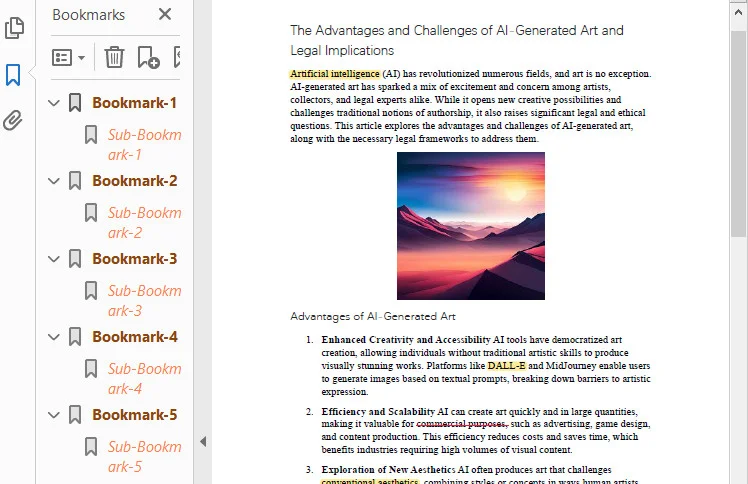
This method creates PDF bookmarks programmatically rather than generating a visible table of contents page inside the document. The bookmarks appear in the PDF reader's navigation panel and allow users to jump to specific sections quickly.
Using Free Spire.PDF for Python, developers can create bookmark structures through its simple APIs and link them to specific pages or coordinates inside the document.
Below is the complete code example:
from spire.pdf.common import *
from spire.pdf import *

# Create a PdfDocument object
doc = PdfDocument()

# Load a PDF file
doc.LoadFromFile("/input/sample.pdf")

# Loop through the pages in the PDF file
for i in range(doc.Pages.Count):
    page = doc.Pages.get_Item(i)

    # Set the title and destination for the bookmark
    bookmarkTitle = "Bookmark-{0}".format(i+1)
    bookmarkDest = PdfDestination(page, PointF(0.0, 0.0))

    # Create and configure the bookmark
    bookmark = doc.Bookmarks.Add(bookmarkTitle)
    bookmark.Color = PdfRGBColor(Color.get_SaddleBrown())
    bookmark.DisplayStyle = PdfTextStyle.Bold
    bookmark.Action = PdfGoToAction(bookmarkDest)

    # Create a collection to hold child bookmarks
    bookmarkCollection = PdfBookmarkCollection(bookmark)

    # Set the title and destination for the child bookmark
    childBookmarkTitle = "Sub-Bookmark-{0}".format(i+1)
    childBookmarkDest = PdfDestination(page, PointF(0.0, 100.0))

    # Create and configure the child bookmark
    childBookmark = bookmarkCollection.Add(childBookmarkTitle)
    childBookmark.Color = PdfRGBColor(Color.get_Coral())
    childBookmark.DisplayStyle = PdfTextStyle.Italic
    childBookmark.Action = PdfGoToAction(childBookmarkDest)

# Save the PDF file
doc.SaveToFile("/output/Bookmark.pdf")

# Close the document
doc.Close()
Below is a preview of the PDF table of contents created using Free Spire.PDF:
Tips for Creating a User-Friendly PDF Table of Contents
- Don't Forget Dot Leaders: Always add a string of period marks (
. . . . .) between your chapter title and the page number. On wide monitors, your reader's eyes will struggle to connect text on the left with numbers on the far right without a visual guide rail. - Keep Bookmarks and Page TOC Synced: Ensure your visual index page matches your left sidebar bookmark panel exactly. When a user clicks a bookmark, it should drop them off at the exact same coordinate as clicking the text link on page one.
- Padding the Clickable Target Box: When mapping link annotations with code or the Acrobat link tool, make your bounding boxes slightly taller and wider than the actual words. This extra padding makes hitting the touch targets significantly easier for readers browsing on mobile screens.
Conclusion
Adding a clear table of contents to PDFs transforms a messy file into a professional document. Among the methods introduced, online tools are best for quick tasks, while Adobe Acrobat suits those who prefer desktop software with strict file compatibility and security. For processing massive files or integrating navigation into automated workflows, Free Spire.PDF for Python is the ultimate choice. Choose the right tool for your workload and start organizing your PDFs today!
Also Read
How to Make a Hanging Indent in Word: 3 Easy & Useful Ways
If you're formatting an academic paper, bibliography, or APA/MLA reference list, you may need to create a hanging indent in Word. Although Microsoft Word includes built-in formatting tools for this, many users still struggle to find the correct button, especially in newer versions of Word. In this guide, you'll learn how to make a hanging indent in Word using three simple methods: manual formatting, keyboard shortcuts, and Python automation for batch document processing.
- Make a Hanging Indent in Microsoft Word Manually
- Create a Hanging Indent in Word Using Shortcut
- Automating Make Hanging Indent in Word with Python
- Troubleshooting & FAQs
- Method Comparison
Make a Hanging Indent in Microsoft Word Manually
If you are wondering how to do a hanging indent on Word for a single document, the Paragraph settings menu is your most reliable approach. This method works in most versions of Microsoft Word and allows you to customize the indent size precisely.
How to set it up:
- Step 1. Highlight the specific paragraphs or the entire bibliography you want to format.
- Step 2. Right-click the highlighted text and select Paragraph... from the context menu. This will instantly open the Indents and Spacing tab.
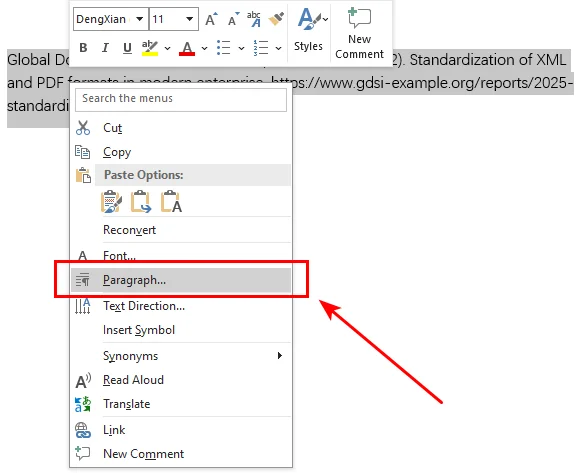
- Step 3. In the Indentation section, find the Special drop-down menu and select Hanging.
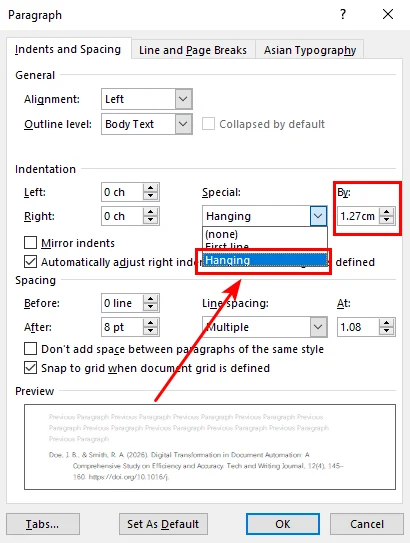
- Step 4. The standard offset for APA or MLA styles is 0.5" (1.27 cm). Hit OK, and your text will snap into place.
Create a Hanging Indent in Word Using Shortcut
While adding a hanging indent in Word using the menu offers precise control, repeatedly opening the Paragraph dialog can become inefficient when working with long citation lists. If you have a long list of citations and want to speed things up, using a keyboard shortcut is more efficient for power users.
Hanging indent shortcut for Windows and Mac:
- On Windows: Press Ctrl + T. Each press increases the indent. To undo it or move it back, press Ctrl + Shift + T.
- On Mac: Press Command + T. macOS does not have a default shortcut to decrease the indent; you can use Command + Z to undo the action immediately, or press Option + Command + Q to reset all paragraph formatting.
These shortcuts are especially useful when editing long documents and applying formatting repeatedly.
Tip: While adjusting your layout, you might encounter stubborn blank lines that disrupt the flow. To tidy up your document efficiently, you can follow this guide to remove blank lines in Word quickly.
Automating Make Hanging Indent in Word with Python
While the manual and shortcut methods are sufficient for casual users, they lose efficiency when you need to handle hundreds of documents or paragraphs scattered across different pages. For large-scale document processing, automation helps maintain consistent formatting while reducing manual work.
In this section, we will demonstrate how to add a hanging indent in Word documents using Free Spire.Doc for Python. This is a free professional library designed for creating, editing, and converting Word documents. It features the ParagraphFormat.SetFirstLineIndent() method, which allows you to shift between first-line and hanging indents simply by adjusting a single parameter.
Install Free Spire.Doc for Python
Before running the code, install the library using pip:
pip install Spire.Doc.Free
Python Code Example (using Free Spire.Doc)
The following Python code shows how to target the first and third paragraphs within an existing Word document and set a hanging indent on these paragraphs.
from spire.doc import *
from spire.doc.common import *

# Load an existing Word document
doc = Document()
doc.LoadFromFile("/input/apa style.docx")

# Access the first section of the document
section = doc.Sections.get_Item(0)

# Format the first paragraph
para1 = section.Paragraphs.get_Item(0)
para1.Format.SetLeftIndent(36.0)
para1.Format.SetFirstLineIndent(-36.0)

# Format the fifth paragraph
para3 = section.Paragraphs.get_Item(4)
para3.Format.SetLeftIndent(36.0)
para3.Format.SetFirstLineIndent(-36.0)

# Save the updated document
doc.SaveToFile("/output/Hanging_Indent.docx", FileFormat.Docx2013)
doc.Close()
In the code above, we use get_Item(4) to target what appears to be the third paragraph. This is because empty lines between text blocks are often counted as individual paragraph objects by the library. If your document has no empty lines, you may need to adjust the index to 2 instead.
Here's the preview of the resulting file and the original Word document:
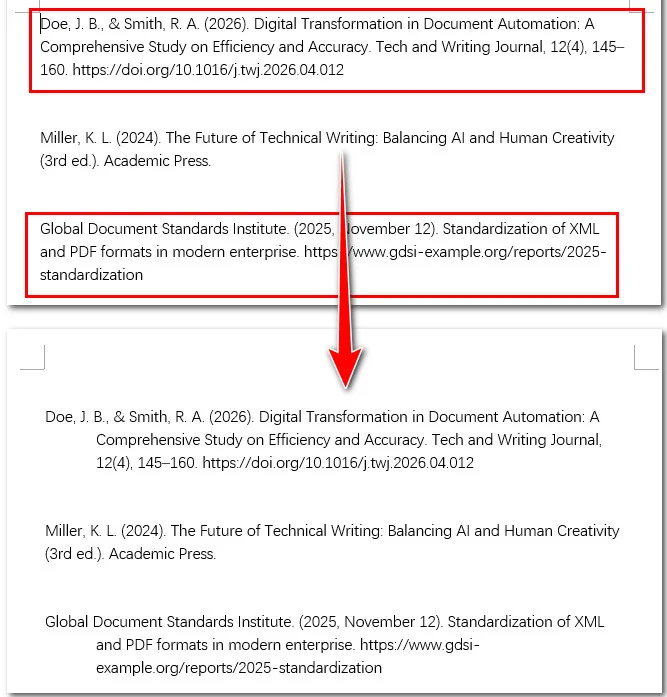
Tip: Once you've perfected your layout, you can also use Free Spire.Doc to convert the Word documents to PDF. This ensures your hanging indents and overall formatting remain perfectly intact across all platforms and devices.
Troubleshooting & FAQs
Q1: Why is Ctrl + T not working in my Word?
This usually happens if another background app has the same shortcut. Check if you have any specialized translation or screen-recording software running. If all else fails, use the manual method above.
Q2: How do I set a hanging indent in Word Online?
The web version is slightly different. Go to the Home tab, click the three dots (...) for more options, select Paragraph Options, and find Special Indent.
Q3: What is the standard size for APA or MLA?
The standard is 0.5 inches (1.27 cm). Most Word versions set this by default as soon as you select "Hanging."
Hanging Indent Method Comparison
Now that we've covered both manual and automated approaches, let's briefly compare when each method works best.
| Method | Best For | Advantages | Limitations |
|---|---|---|---|
| Manual Formatting | One-time edits | Simple and built into Word | Slower for repeated tasks |
| Keyboard Shortcut | Fast document editing | Quick and convenient | Limited customization |
| Python Automation | Batch document processing | Efficient and consistent | Requires coding knowledge |
Conclusion
In summary, manual clicks and shortcuts within Microsoft Word offer a quick, convenient solution for occasional edits and one-off tasks. However, for those looking to bypass the office suite and automate formatting workflows, Free Spire.Doc for Python delivers speed and precision. Choose the tool that aligns with your project goals and start building professional, perfectly formatted documents today!