OpenXML is a widely used format for creating and manipulating Microsoft Office documents, including Excel files. It provides a structured, XML-based representation of spreadsheet data, making it ideal for interoperability and automation. Converting an Excel file to OpenXML allows users to extract and process data programmatically, while converting OpenXML back to Excel ensures compatibility with Microsoft Excel and other spreadsheet applications. This article will guide you through the process of converting Excel to OpenXML and OpenXML back to Excel in React using Spire.XLS for JavaScript.
Install Spire.XLS for JavaScript
To get started with converting Excel to OpenXML and OpenXML to Excel in a React application, you can either download Spire.XLS for JavaScript from the official website or install it via npm with the following command:
npm i spire.office
The downloaded product package has been integrated Spire.Doc for JavaScript,Spire.XLS for JavaScript,Spire.PDF for JavaScript,Spire.Presentation for JavaScript. To use the functionality of Spire.XLS for JavaScript, you need to copy the corresponding files (spire.xls.js, Spire.Xls.Wasm.zip, spire.common.js, Spire.Common.Wasm.zip, and _framework) to the project's "public" folder. At the same time, in order to ensure text rendering, the related font files can be added with custom paths. In the following example, the font addition path is: public\static\font.
For more details, refer to the documentation: How to Integrate Spire.XLS for JavaScript in a React Project.
Convert Excel to OpenXML with JavaScript
Converting an Excel workbook to OpenXML format can be easily achieved using the Workbook.SaveAsXml() method provided by Spire.XLS for JavaScript. Below are the key steps:
- Load the font file to ensure correct text rendering.
- Create a Workbook object using the new wasmModule.Workbook() method.
- Load the Excel file using the Workbook.LoadFromFile() method.
- Save the Excel file as an OpenXML file using the Workbook.SaveAsXml() method.
Code example:
- JavaScript
import React, { useState, useEffect } from 'react';
function App() {
  const [wasmModule, setWasmModule] = useState(null);
  // Load Spire.XLS
  useEffect(() => {
    (async () => {
      try {
        const publicUrl = process.env.PUBLIC_URL || '';
        const spireModule = await import(/* webpackIgnore: true */ `${publicUrl}/spire.xls.js`);
        const rawModule = spireModule.default || spireModule;
        window.wasmModule = typeof rawModule === 'function'
          ? await rawModule({ locateFile: p => p.endsWith('.wasm') ? `${publicUrl}/${p}` : p })
          : rawModule;
        setWasmModule(window.wasmModule);
      } catch (error) {
        console.error('Failed to load spire.xls.js WASM module:', error);
      }
    })();
  }, []);

  // Function to convert Excel to OpenXML
  const ExcelToOpenXML  = async () => {
    const wasmModule = window.wasmModule.spirexls;

    if (wasmModule) {
      // Load font into Virtual File System (VFS)
      await window.spire.FetchFileToVFS('Arial.ttf', '/Library/Fonts/', `${process.env.PUBLIC_URL}/static/font/`);

      // Load input file into Virtual File System (VFS)
      const inputFileName = 'sample.xlsx';
      await window.spire.FetchFileToVFS(inputFileName, '', `${process.env.PUBLIC_URL}/static/data/`);

      // Create a new workbook
      const workbook = new wasmModule.Workbook();

      // Load an existing HTML file
      workbook.LoadFromHtml({ fileName: inputFileName });

      // Specify the output OpenXML file path
      const outputFileName = 'ExcelXML.xml';

      // Save the workbook as an OpenXML file
      workbook.SaveAsXml({ fileName: outputFileName });

      // Read the saved file and convert to Blob object
      const modifiedFileArray = window.dotnetRuntime.Module.FS.readFile(outputFileName);
      const modifiedFile = new Blob([modifiedFileArray], { type: 'application/xml' });

      // Create a URL for the Blob and initiate download
      const url = URL.createObjectURL(modifiedFile);
      const a = document.createElement('a');
      a.href = url;
      a.download = outputFileName;
      document.body.appendChild(a);
      a.click();
      document.body.removeChild(a);
      URL.revokeObjectURL(url);

      // Clean up resources used by the workbook
      workbook.Dispose();
    }
  };

  return (
    <div style={{ textAlign: 'center', height: '300px' }}>
      <h1>Convert an Excel File to OpenXML Using JavaScript in React</h1>
      <button onClick={ExcelToOpenXML} disabled={!wasmModule}>
        Convert
      </button>
    </div>
  );
}

export default App;
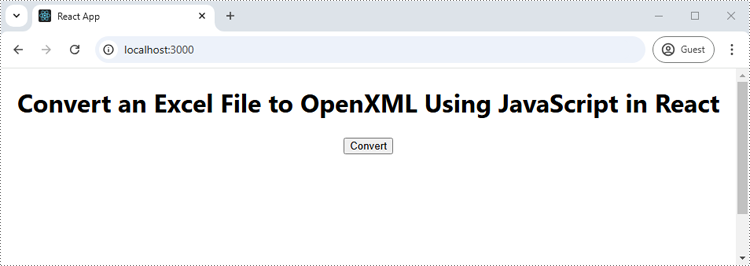
Run the code to launch the React app at localhost:3000. Once it's running, click on the "Convert" button to save the Excel file as an OpenXML file:
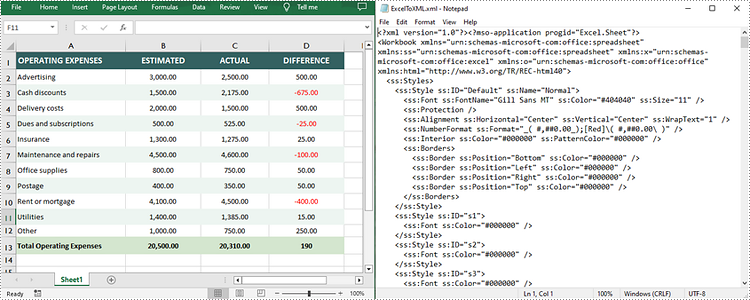
The below screenshot shows the input Excel file and the converted OpenXML file:
Convert OpenXML to Excel with JavaScript
To convert an OpenXML file back to Excel, you can use the Workbook.LoadFromXml() method to load the OpenXML file and the Workbook.SaveToFile() method to save it in Excel format. Below are the key steps:
- Load the font file to ensure correct text rendering.
- Create a Workbook object using the new wasmModule.Workbook() method.
- Read an OpenXML file into a stream using the wasmModule.Stream.CreateByFile() method.
- Load the OpenXML file from the stream using the Workbook.LoadFromXml() method.
- Save the OpenXML file as an Excel file using the Workbook.SaveToFile() method.
Code example:
- JavaScript
import React, { useState, useEffect } from 'react';
function App() {
  const [wasmModule, setWasmModule] = useState(null);
  // Load Spire.XLS
  useEffect(() => {
    (async () => {
      try {
        const publicUrl = process.env.PUBLIC_URL || '';
        const spireModule = await import(/* webpackIgnore: true */ `${publicUrl}/spire.xls.js`);
        const rawModule = spireModule.default || spireModule;
        window.wasmModule = typeof rawModule === 'function'
          ? await rawModule({ locateFile: p => p.endsWith('.wasm') ? `${publicUrl}/${p}` : p })
          : rawModule;
        setWasmModule(window.wasmModule);
      } catch (error) {
        console.error('Failed to load spire.xls.js WASM module:', error);
      }
    })();
  }, []);

  // Function to convert OpenXML to Excel
  const OpenXMLToExcel = async () => {
    const wasmModule = window.wasmModule.spirexls;

    if (wasmModule) {
      // Load font into Virtual File System (VFS)
      await window.spire.FetchFileToVFS('Arial.ttf', '/Library/Fonts/', `${process.env.PUBLIC_URL}/static/font/`);

      // Load input file into Virtual File System (VFS)
      const inputFileName = 'in.xml';
      await window.spire.FetchFileToVFS(inputFileName, '', `${process.env.PUBLIC_URL}/static/data/`);

      // Create a new workbook
      const workbook = new wasmModule.Workbook();

      // Read an OpenXML file into a stream
      let fileStream = new wasmModule.Stream(inputFileName);
      // Load the OpenXML file from the stream
      workbook.LoadFromXml({ stream: fileStream });

      // Specify the output Excel file path
      const outputFileName = 'XMLToExcel.xlsx';

      // Save the OpenXML file as an Excel file
      workbook.SaveToFile({ fileName: outputFileName, version: wasmModule.ExcelVersion.Version2013 });

      // Read the saved file and convert to Blob object
      const modifiedFileArray = window.dotnetRuntime.Module.FS.readFile(outputFileName);
      const modifiedFile = new Blob([modifiedFileArray], { type: 'application/vnd.openxmlformats-officedocument.spreadsheetml.sheet' });

      // Create a URL for the Blob and initiate download
      const url = URL.createObjectURL(modifiedFile);
      const a = document.createElement('a');
      a.href = url;
      a.download = outputFileName;
      document.body.appendChild(a);
      a.click();
      document.body.removeChild(a);
      URL.revokeObjectURL(url);

      // Clean up resources used by the workbook
      workbook.Dispose();
    }
  };

  return (
    <div style={{ textAlign: 'center', height: '300px' }}>
      <h1>Convert an OpenXML File to Excel Using JavaScript in React</h1>
      <button onClick={OpenXMLToExcel} disabled={!wasmModule}>
        Convert
      </button>
    </div>
  );
}

export default App;
Get a Free License
To fully experience the capabilities of Spire.XLS for JavaScript without any evaluation limitations, you can request a free 30-day trial license.